Attention: New Currency, Old Magic
Have you ever been in the midst of doing something that was once complicated, and caught yourself thinking “OH MY GOD I’M DOING IT!” right…
Have you ever been in the midst of doing something that was once complicated, and caught yourself thinking “OH MY GOD I’M DOING IT!” right before completely messing it up? Maybe it was typing before you mistyped a word. Maybe it was playing a piece of difficult music before missing a note. Or leaping hurdles before stumbling. I’ve had that happen a lot. It’s as if the power of attention itself turns into a distraction.
Moments like that make me think about what attention is, and what kind of power attention has. What is prayer if not attention? Meditation is about where the attention is. During one of my favorite yoga videos, the instructor says “Where are your thoughts?”
Attention is Currency
Attention is spent by what we give it to — and in this modern age of social media, infotainment, and incessant distraction — it’s a more valuable commodity than many realize. Time is money, but attention is how our mind spends that time.
Humans have been thinking about attention a long time — Confucius said ‘Be attentive to what you do, never consider anything unworthy of your attention.’ Psychology first became accepted as a science with the opening of a psychology lab in 1879, and William James wrote about attention in his 1890 text ‘The Principles of Psychology.’ He wrote, ‘Attention is the taking possession by the mind, in clear and vivid form, of one out of what seem several simultaneously possible objects or trains of thought. Focalization, concentration, of consciousness are of its essence.’
We’ve described disorders relate to attention, theologians have linked attention to prayer. Magic tricks are focused on diverting attention.
In other words, we’ve long linked attention to things of importance. And now, advertisers, social media sites, and even journalism outlets vie for our attention. Metrics such as engagement and time reading have been created around our attention. Even this site measures how much attention is given to articles. So while we’ve long acknowledged the importance of attention to our existence, attaching metrics and building economies around it is a relatively new thing. Access to the sort of technology that can easily divert and command attention is becoming more and more refined and powerful.
Where is My Mind?
Your head will collapse, and there’s nothing in it
And you’ll ask yourself
Where is my mind? — The Pixies
Earlier I mentioned my favorite yoga video, where one of the instructors asked “Where are your thoughts.” It’s a wonderful moment, following a particularly challenging flow, but one that was repetitive enough to allow the mind to start wondering if unfocused. I could always tell how well the rest of my session would go by how I responded to that simple question, one that resembles the song from the Pixies enough that they’re inextricably linked.
As you read, interact with your phone, talk with your loved ones, cook dinner, and perform your daily tasks — where is your mind? Do you notice when it goes on autopilot? Are you aware of when TikTok or YouTube or Facebook take it away?
For me, controlling my attention comes down, first, to noticing it. Awareness of where my attention is allows me to then think of where I want it allocated.
Deep Space Nine — Trauma and Attention
In the first episode of Deep Space Nine, Sisko is introduced to a species that doesn’t understand how our experience of time works. As they try to search his mind, they find that due to the trauma of his wife’s death, that he still lives in the past — which is at odds with how he is saying time works. “But you are here,” they insist. It’s a wonderful way of explaining ‘trauma brain.’
One of the experiences I have with attention is how quickly it can be ripped away when something triggers one of those traumatic memories. These flashbacks can manifest physically, or even emotionally, and for a moment my attention is torn away from where I am to where I was — which is often where I don’t want to be. I often find myself engaging in tricks to bring my consciousness back to where I am — bringing my attention to my surroundings, my senses, and engaging myself with the world around me. I try to identify the feelings I’m feeling, acknowledging that I am experiencing a flashback, and grounding myself by recognizing things I can hear, touch, smell, or see around me as explained in the flashback halting protocol.
Another way I bring my mind back to where I need it to be when dealing with triggers, attention deficits, or even angry outbursts, is breathing. I’ve written about breath meditations before — and I’ve found that box breathing is a great way for me to bring my thoughts back in line with my body in the moment.
Handcraft in the Digital Age
William James wrote “My experience is what I agree to attend to,” and I often find myself attending to handcrafts in this digital age. Recently, I made this blanket for my step-granddaughter over 114 hours, and it represents attention I didn’t wholly put into the information economy.
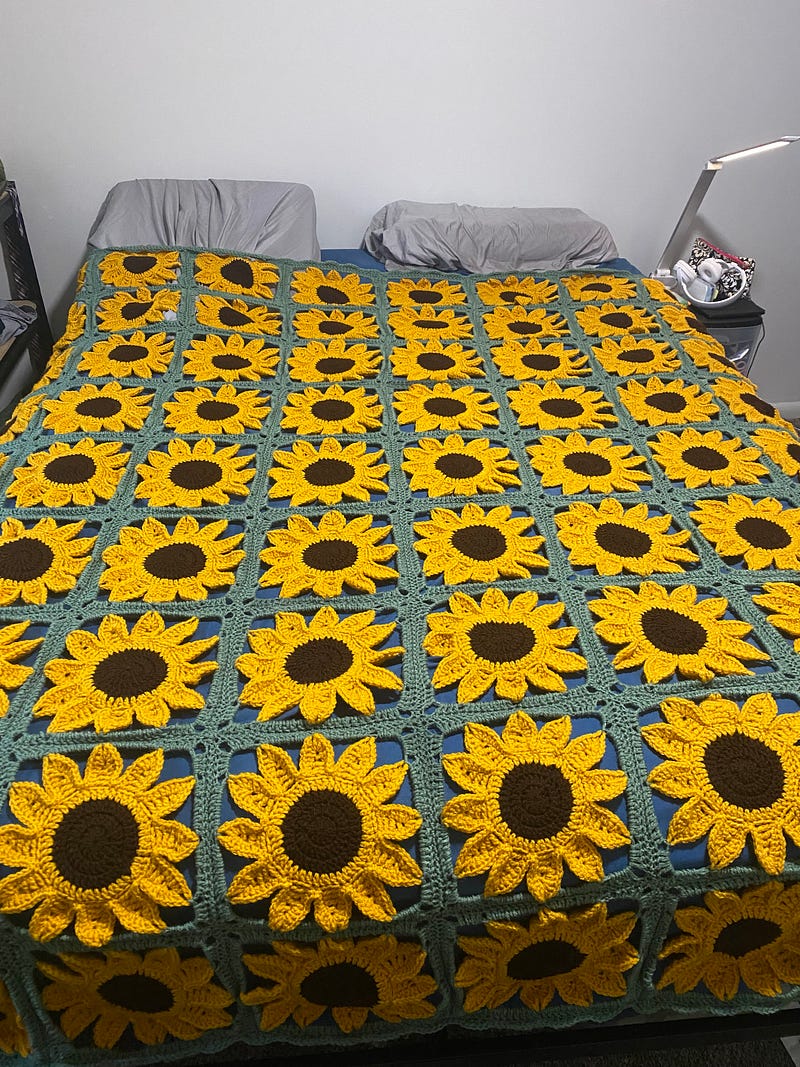
Handcrafts are another way to pull my attention back towards myself. It’s a way to physically represent and channel just a bit of the magic of my own attention.
With so many digital things vying for our attention from our watches to our phones —I find that handcrafted goods are an amazing way to reconnect with the world and others. Our craft, whether it be textile arts, beermaking, agriculture, or writing are not just acts of faith in ourselves and our own creative potential, but in the world that we ask to hold them.
Attention is, ultimately, an old form of magic, as we can manifest our attention and channel it by bringing things to be in this world. Think of all the advice that starts with ‘visualize what you want.’
What is prayer but directed attention?
Eclipse
“The moment one gives close attention to anything, even a blade of grass, it becomes a mysterious, awesome, indescribably magnificent world in itself.”
Henry Miller, via Sunbeams (Page 78)
It’s largely accepted that the best way to find what someone cares about is to find what they spend time doing — or, said another way, what they give their attention to. Pink Floyd’s song, Breathe, declares, “And all you touch and all you see is all your life will ever be.” The moments of our lives are assembled through our attention, and I often find myself wondering what a scorecard of my time spent would show. Would I, in the end, feel I spent enough time writing? Talking with people I care about? Crafting things I want to see in the world?
If attention is part of my life’s currency — how do I spend that precious resource, and what will it say about me?
Thank you, so much, for your time - and, of course, your attention!
Sources
https://en.wikipedia.org/wiki/Attention

Rothschild, B. (2000). The Body Remembers: The Psychophysiology of Trauma and Trauma Treatment. New York: W.W. Norton. via https://makingsenseoftrauma.com/wp-content/uploads/2016/04/Flashback-Protocol.pdf