Cannabis Recalls: A Brief State by State Analysis
Let’s Analyze a Data Set Together!
I have compiled the state by state cannabis recall data before, but it’s been quite some time since I’ve done so and the last compilation date was in August of 2024. I’ve had good reasons for that decision, but my feelings on this matter are wholly unimportant, so let’s move on.
Since I last compiled the data, more states have come online, with five (Maine, Massachusetts, Missouri, Montana, and New York) creating new public-facing recall pages that specifically address cannabis or hemp recalls within their state from the last time I looked at the data. Several have also updated theirs, with California doing the most meaningful overhaul of their available data which goes hand in hand with their renewed vigor towards their recall program. 14 states currently curate recall lists, and the rest of the data was collated from media reports, etc. This data is about cannabis recalls — not hemp (Minnesota has a great website for cannabis related recalls that currently only includes information about a hemp product).
If we are looking at cannabis recall data that is collected by regulatory institutions solely through an organizational epistemology lens, the collection and dissemination of these lists indicates that there is a focus on consumer safety in these states. For those states that do not compile these lists, it shows (at best) indifference towards either cannabis users or the creation of measures to ensure that products can be effectively tested and recalled.
I believe the best way to move through this information is state by state, and then we’ll go over some overall trends and lessons learned at the end. Not all states with cannabis programs are mentioned in this work, meaning I could find no recalls for those states, nor do they have a page that I can monitor to determine if they have recalls. Obviously, this is sub-optimal for an action meant to alert consumers to an issue. Not collecting and sharing this data in a centralized location demonstrates apathy towards cannabis user safety, or ineffective regulations in the nascent industry that can address consumer safety.
General Information
Curation of this data set is performed manually (it has taken me over 50 hours to curate this dataset so far, and this update took 16 hours alone). The next, most important step is to move the over-500 row spreadsheet into a database home. Over the time that I have curated it, I have added fields of interest and backfilled them, etc. This work is obviously impacted by state willingness to share information about recalls. While many states have dedicated websites to support recalls, many do not and the recalls are announced by the press (or, worse, leaked to reddit), and in worst-case, there are some states that used to announce recalls on a website but now no longer do so, leaving the citizens in their state in the lurch when it comes to understanding the safety of their product.
I have been refining taxonomies and categories from the beginning, and have now collated enough information to go into detail about pesticide usage across the states from some of the breakout data. I have several classifications of data that can be used. If you notice a great upswing in some counts in some of the more specific categories, especially those where I break out ‘Multiple,’ this is why, as the context is different (in one case, I am saying ‘what how many recalls are these attributes associated with?’ and in the other, I am asking ‘how many recalls are related to these categories and reasons?’). ‘Multiple’ gives us an opportunity to discuss this.
In a data set of 555 recall actions, the incidence of 78 Multiples is notable. 11 states have recalls that encompass multiple types of products (more on that soon) or multiple types of recall reasons — multiple contains multitudes (dozens of categories, in fact).
What is a Recall and What Kind of Data Would a Healthy Recall Program Produce?
Let’s get to the heart of what a recall is — it is pulling product off of store shelves, and alerting possible consumers to the fact that a product may be deemed faulty. That means that, in essence, a recall would require someone telling the public that something may have gone wrong in the production of something so they can make a decision as to whether or not something they’ve purchased has been impacted. It feels like we are belaboring the point, but it helps us get a clearer picture of how to best tell the public about such a thing.
I have been saying since writing about these recalls that a ‘healthy’ recall notice would include the following attributes:
Announced Publicly
In a Centralized Place
Dates Available for Sale
With Branding of Product
Include Batch Information
Dates of Harvest / Packaging
With Clear instructions on how to return product ; consumer refunds for products
Including a Clear Reason for Recalls
Possible Health Impacts of Repeated Exposure
When I look at states for their recall information, I’m generally looking at how much they conform to the above. The absolute best cases will include photographs — but they don’t have to! A lot of the labeling information commonly transmitted can be just as helpful.
State By State Analysis
Alaska
Alaska has had two recalls — in 2019 and 2023. They do not have a dedicated page for recalls, and doing so would be a huge improvement for them. The recalls that they list come with the violation information, which can be difficult for patients to parse. It does not include images of the product that could be recognized by people who purchased or used it. There’s a lot of room for improvement here, and Alaska should show dedication to her citizen’s health by undertaking them. It’s great they do collate all the information, though!
With so little data it’s hard to determine what is prevalent.
Arizona
Arizona has a recall page — which they didn’t use for several recalls that happened. That’s extra disappointing — if people are looking to the main Arizona page to get information on recalls, they could easily be misled into thinking there aren’t any when there are. It is far more disappointing to have a page or mechanism that is established that goes unused than to have one that isn’t established at all.
Do better, Arizona. A lot better. You’re so close!
According to the flowchart found here, it’s possible that there might have been product that hasn’t QUITE been recalled and then not announced, but I’m unsure what would make them ‘deem it necessary’ for a recall notice to be administered. If the intent of recalling product is to alert a consumer to the
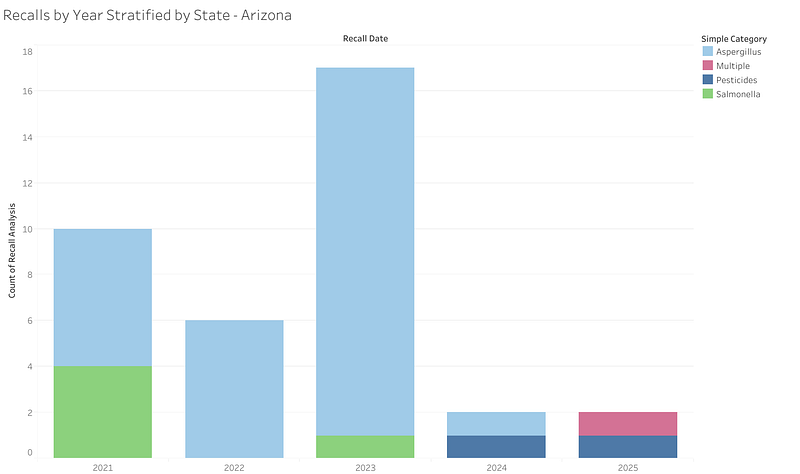
The ‘Multiple’ in 2025 was a recall that involved both Aspergillus and Lead, and the two pesticides that were involved in recalls were spinosad and piperonyl butoxide.
California
California has absolutely made the hugest strides in the recall game since I last wrote about it. They fleshed out their recall page to include more information that is exactly what you’d expect and hope to see. It includes images of the product when it’s available, has information on both the parent company and the brand. They are now producing robust data. While their ‘other’ categories are becoming overburdened and they should rethink areas of their taxonomy now that they have more data under their belt, the strides they have taken forward are nothing less than extraordinary. Let’s take a look.
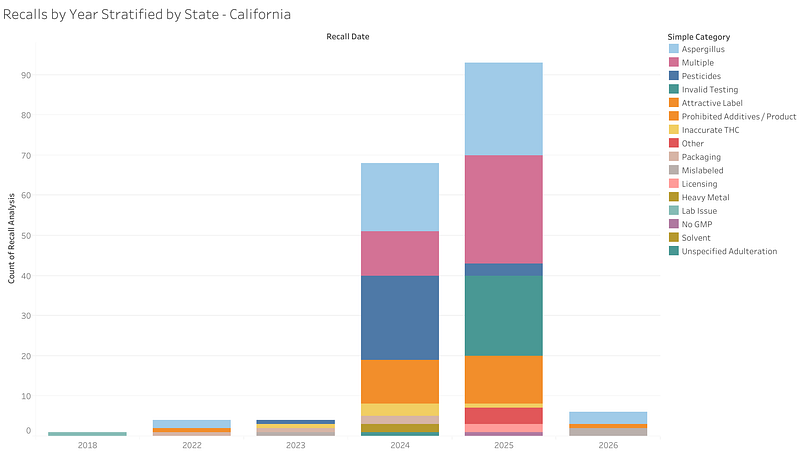
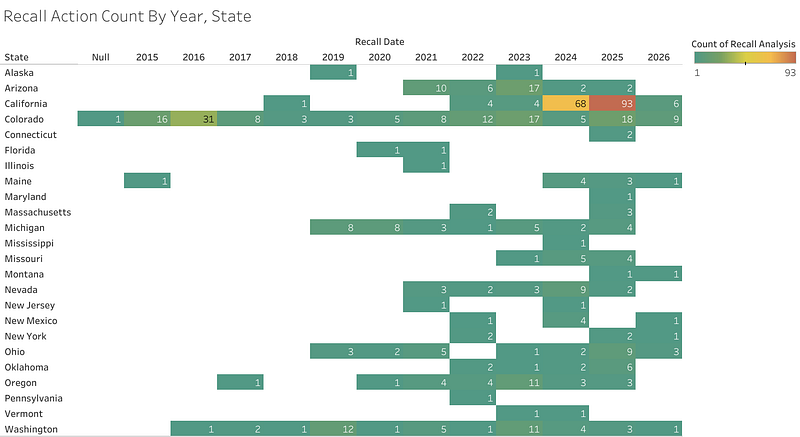
You can see that there was a huge step up in recall activity between 2025 and 2025. Note also that while Aspergillus is the category with the most recalls overall, that ‘Multiple’ as a category overtook it in 2025.
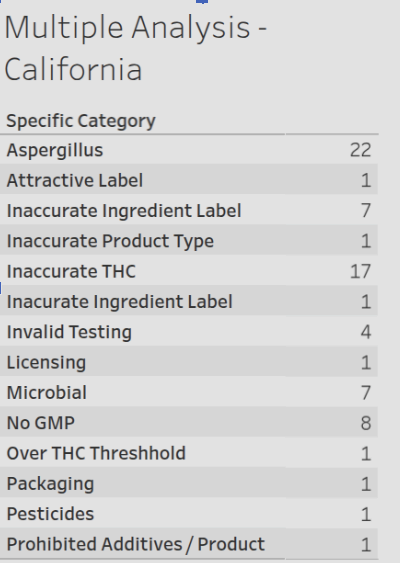
Aspergillus dominates the state reason for recalls.
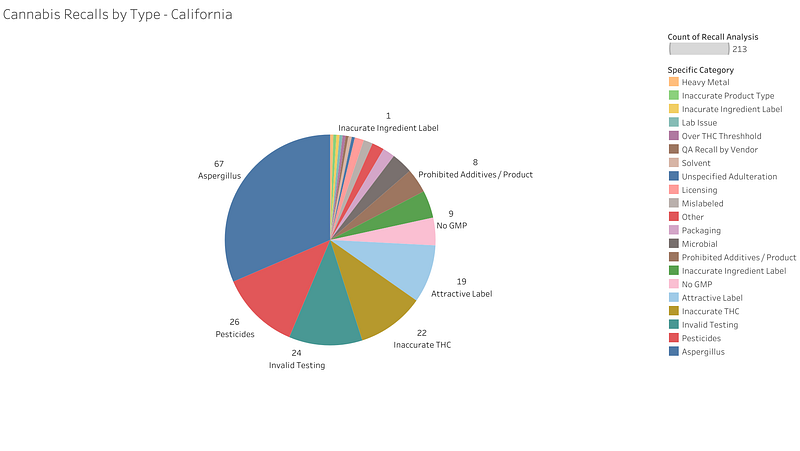
And while Aspergillus is far ahead of the other reasons, pesticide use is alive and well. Here’s where California can fine-tune some of their recall data — there were many recalls that were non-specific about the pesticides used.
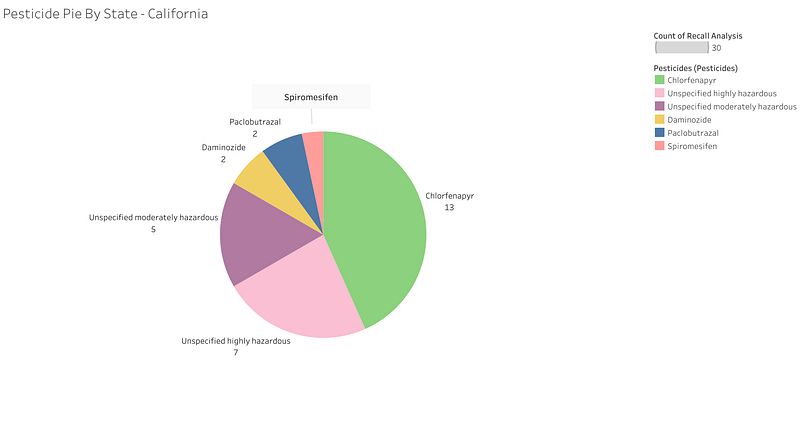
Unfortunately while it can help determine the severity of the symptoms that might be experienced, it doesn’t help citizens determine if they have symptoms related to that pesticide in particular. Given how little we know about impact of pesticides when heated and inhaled, it’s important that as much information get to the consumer as possible so they can be sure that what they experience isn’t related to the product recall.
The sheer number of recalls is impressive, and marks a huge upswing in recall activity across the state. It’s no surprise that such a high standard of recalls comes from the Golden State — I hope that others take note of their exceptional work in the area.
Colorado
Colorado has been at the forefront of cannabis recalls for a while, although they don’t actually call what they do a recall. Instead, they call them “Health Safety Advisories.” Before they were collated on the state level, they were collected on a city level (and the recalls were largely associated with pesticides). Now, there is a centralized area on their website where this information is shared. The advisories include information about the product, but does not include product pictures, but does have a list of stores where the product may have been purchased.
Pesticides dominate the recall landscape in Colorado.
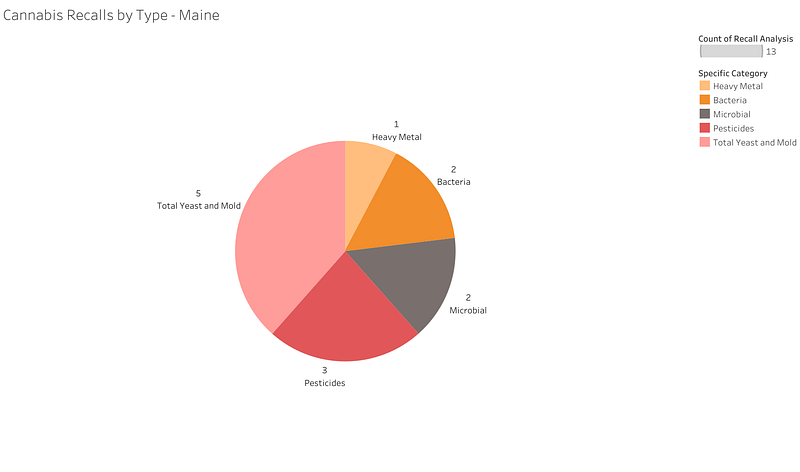
Myclobutanil is the pesticide that is most frequently found as part of these recall actions.
Year over year, multiple reasons for recalls are becoming more frequent.
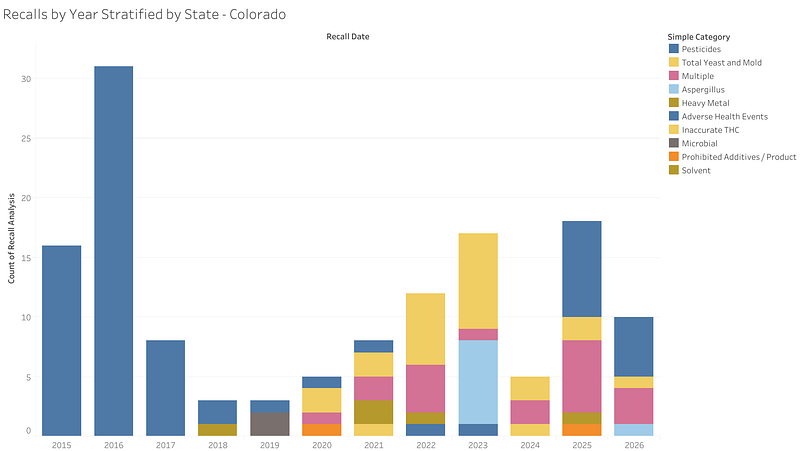
While recalls were lagging in 2024, they picked back up in 2025, and are going on full steam in 2026.
When multiple reasons for a recall exist in CO, they often include Total Yeast and Mold, Aspergillus, and heavy metals within their categories.
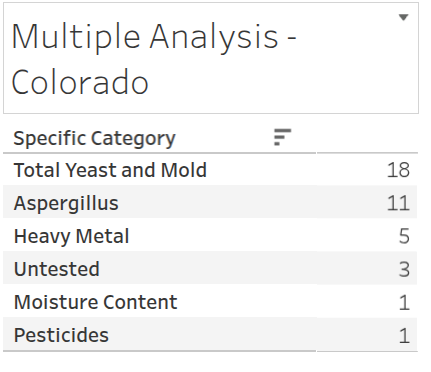
Colorado’s program is strong and is obviously adept at picking up pesticide use. A couple of tweaks to their website to help connect consumers with product pictures impacted would be a huge improvement. Since they are not calling these recalls, I wonder why that is. It’s not the only thing I wonder — what is the efficacy of the advisories, are they recording the data to appropriately determine that? I also wonder about what happened on 1/22/2026.
Connecticut
Connecticut had two recalls in 2025. That’s it.
There are so many ways that the Connecticut cannabis market is terrifying. Overpriced and an entirely captured market ensure that information is hard won. And there’s been a lot of information hard won by state cannabis activists, who helped lead to the country’s first cannabis ombudsman.
The issue? The best place to find information about recalls isn’t from the state, but from the media. Cannabis has been legal in Connecticut for far long enough that this information could be published. Given how forward-facing the state is with other portaled information, this would be a huge step to supporting CT citizens in ensuring the cannabis that they are consuming is safe.
Florida
Much like CT, Florida has had two recalls that were in the prior reporting period. What’s interesting, however, is the scientific research done on the FLMedicalTrees subreddit’s reaction to contaminated products — and it is indicative that FL would do well to invest some regulatory and operational infrastructure to support a more robust recall program.
Illinois
Illinois continues to disappoint. As with last time, the only recalls we know about within the state were due to the press. Here’s hoping that Illinois gets inspired!
Maine
Maine made huge steps in getting their recall information together! They put together a recall portal, and they have done an absolutely incredible job. It includes information and pictures. The last time I compiled this information, I only had information from the press on a recall that happened in 2015. Today it’s a totally different story, and it’s great to see Maine invest in their citizen’s safety!
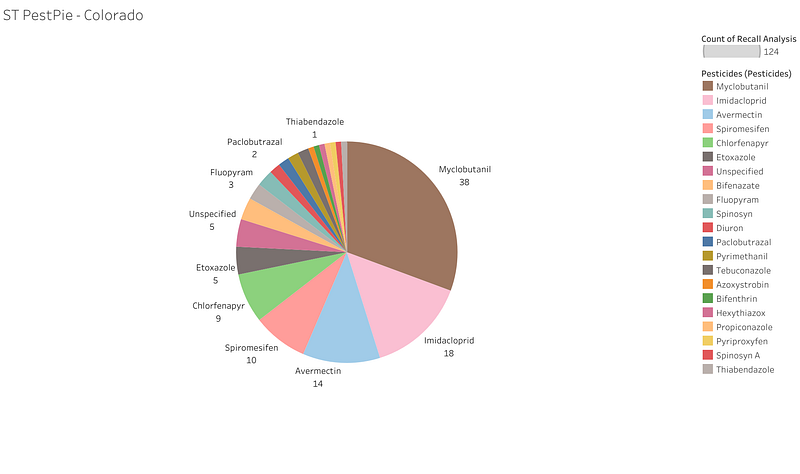
Maine’s recalls are mainly linked to Total Yeast and Mold.
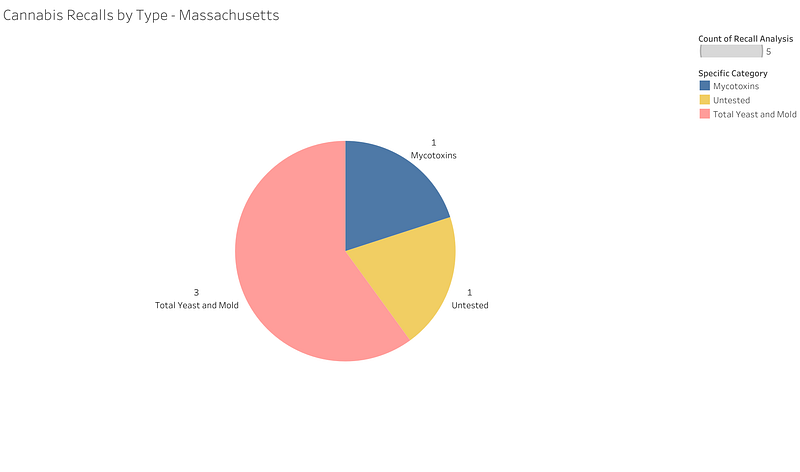
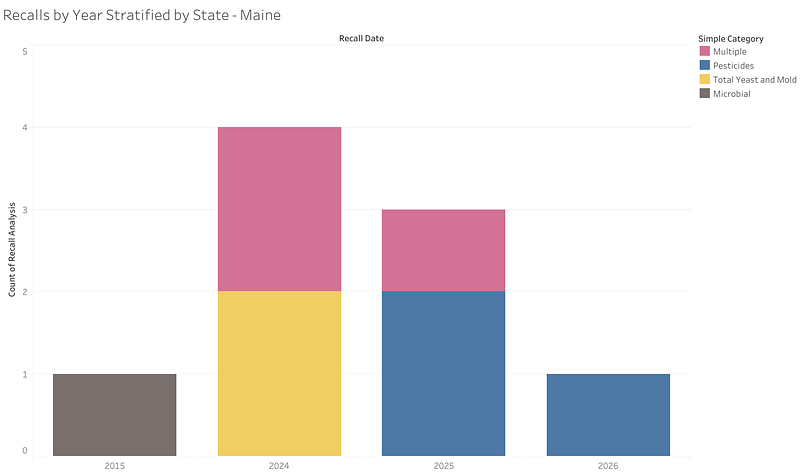
Laid out by reason you can see that Maine does have a lot of Multiples, which is to be expected. While Total Yeast and Mold dominates, their pesticide panel is impressive.
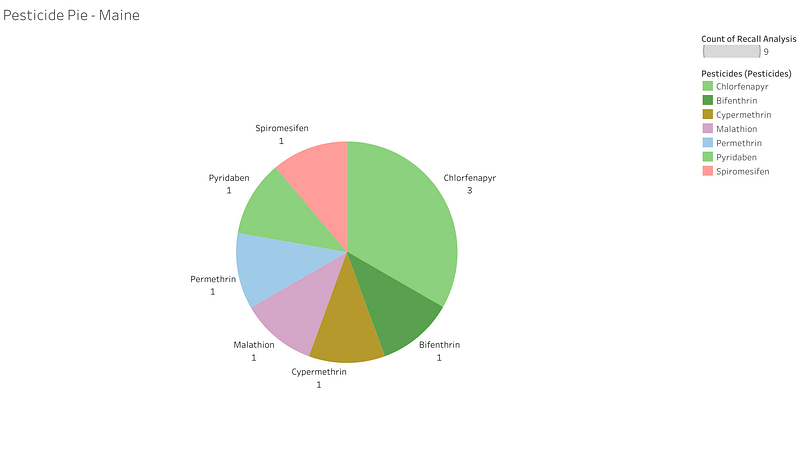
Well done, Maine!
Maryland
I always have a lot of expectations for Maryland, but that’s because it’s my home state (shoutout to PG County). While I couldn’t find a repository where all of the recalls would be stored, I did ultimately find the single recall for coliforms that Maryland implemented on their own website. It’s all in reach for you, MD!
Massachusetts
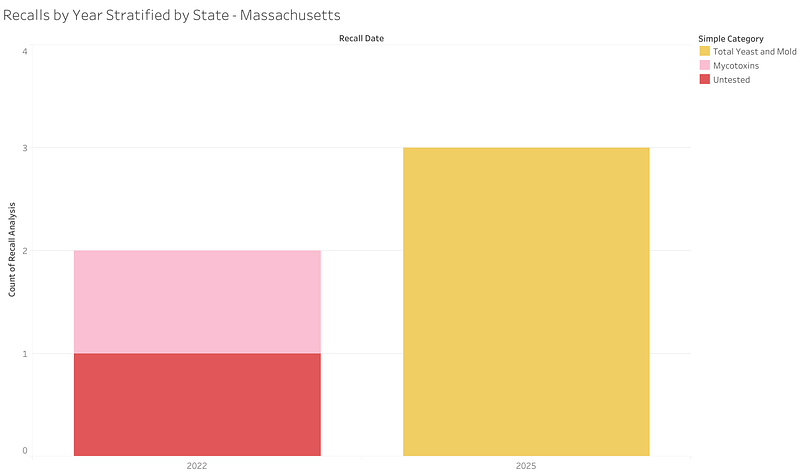
MA has done a great job of putting recalls in a centralized place, but they still seem to be working on what information they are going to be disclosing and at what granularity. Regardless, we were able to see three recalls that have occurred, since they set up the page bringing them to five total.
Michigan
Michigan has been forthcoming with their recall information for a while, but there is room for improvement. They could include package information, sale and harvest dates, information about where the product could have been purchased, and images.
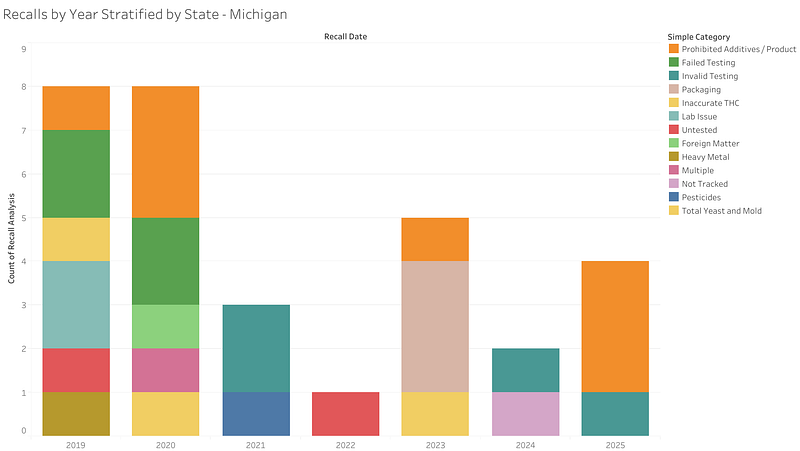
The most prevalent recalls are those with prohibited additives or prohibited products. Unfortunately the state doesn’t go into detail about what those additives or prohibited products are, except in the case of MCT oil, and there are only two recalls related to pesticides from 2019 and 2020.
Mississippi
Mississippi has had a single cannabis recall in 2024, for Total Yeast and Mold, but they’ve done a fabulous job of getting a centralized portal up and waiting for people to find the information.
My issue is with the use of remediation in the state. The statement about the recall included “Cannabis Program to take immediate action including additional testing of these products, the results of which demonstrated the necessity for recall and remediation of the specified products.”
The continuation of the cannabis industry and its regulators to find that it is an acceptable practice to remediate cannabis that has failed testing never fails to disgust me.
Missouri
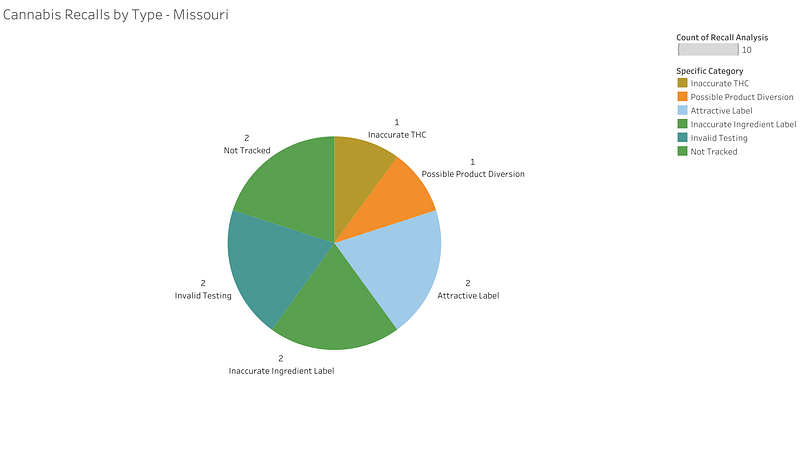
Missouri’s recall portal is new, and is exciting for how much information they include, the sole pieces of information missing are product photos and dates. They have a reasonable mix of recall reasons, in addition to indications that they are stepping up their safety and recall efforts.
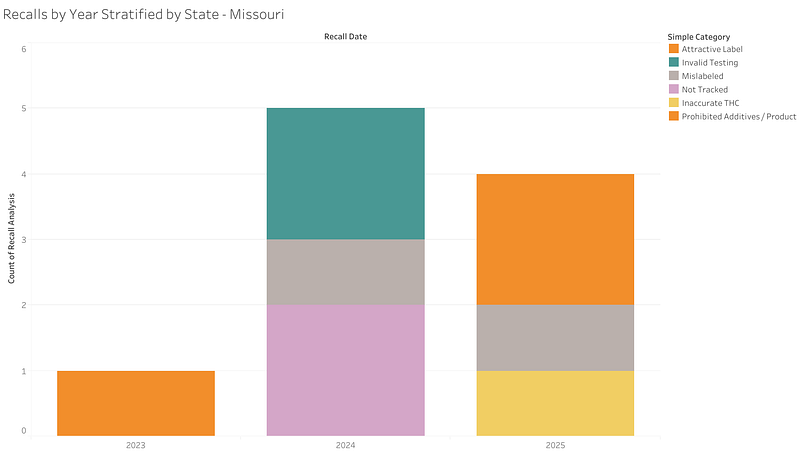
When you look at the recalls by reason, it looks like the state is pretty well-balanced.
Montana
Montana has also set up a new portal, and had a recall in 2024 and in 2025 — one for untested cannabis and one for an unspecified contaminant. I would love to see them use this tool to give more exact information!
Nevada
Nevada has had a portal for a while, and you can see that they had a step up in recalls in 2024 before a large stepdown.
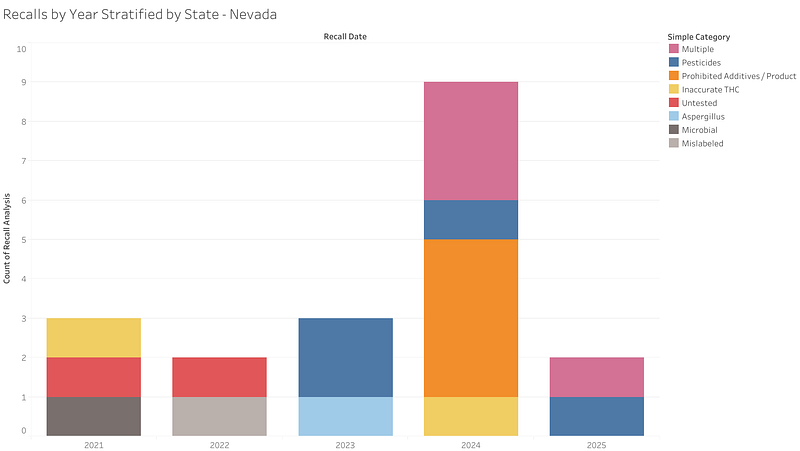
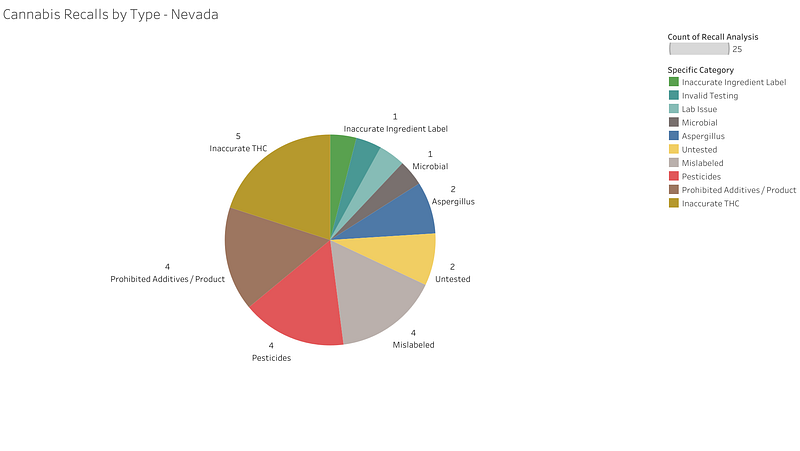
Nevada has quite a few multiples, so if we look at what the ‘reason mix’ is within the state, we’d see the following chart.
New Jersey
New Jersey does have a centralized recall site with information, but there has only been one recall since it was created (and one that pre-dates it). One recall in 2022 was for Total Yeast and Mold and one in 2024 was for Foreign Matter contamination. They could improve their portal with some product pictures, but it’s a great start, and I’m excited to see how their regulatory program around recalls develops.
New Mexico
New Mexico has had a portal for recalls for a while, allowing the public to look directly at recall orders. The only thing I would improve upon is having some product pictures to make it more citizen and consumer facing — so that they can easily recognize if they have purchased the product or not.
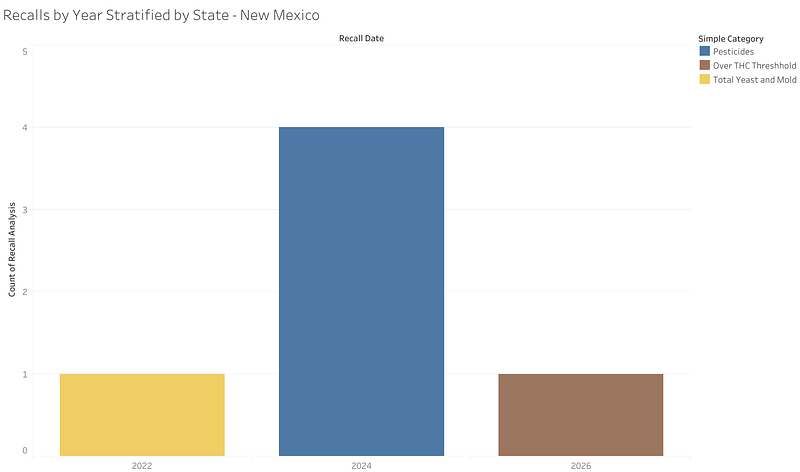
Malathion and Spinosyn are the pesticides that were used — malathion was involved in two recalls.
New York
A big welcome to New York’s new portal. It could use pictures of the product in question, and it’s a bit fiddly to get a historical view of things (it separates recalls into current and prior), but when you think of wanting to get current issues in front of people ASAP it’s overall smart.
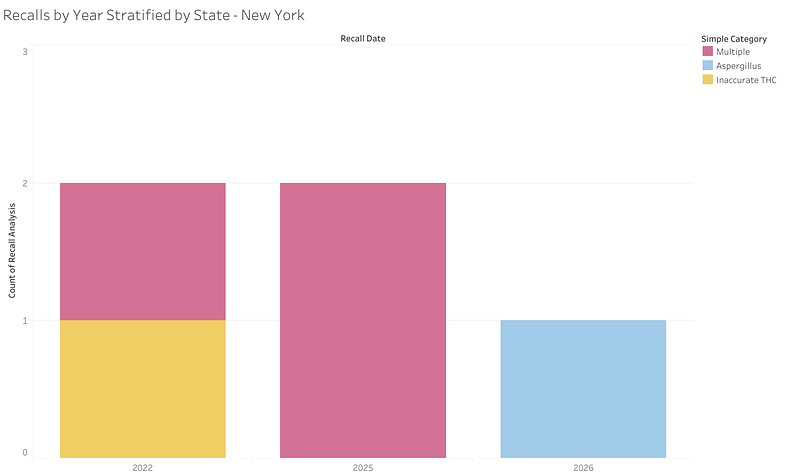
Multiple reasons make a lot of sense but can really spike counts, so let’s see what the actual mix of issues looks like.
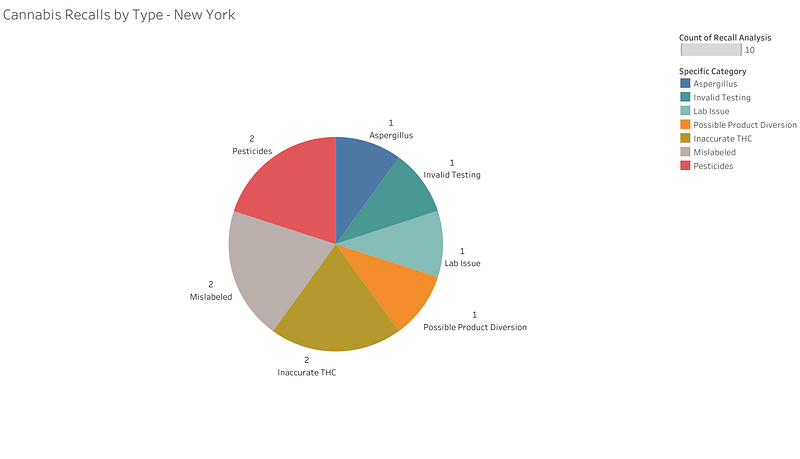
Unfortunately, those pesticides aren’t specified, and that would be one of the biggest improvements the state could make.
Ohio
Ohio has a steady, midwestern work ethic when it comes to their recall page. They show the information that you need (no product pictures, but enough information to identify the products if needs be). It’s great. It’s also interesting to look at the data.
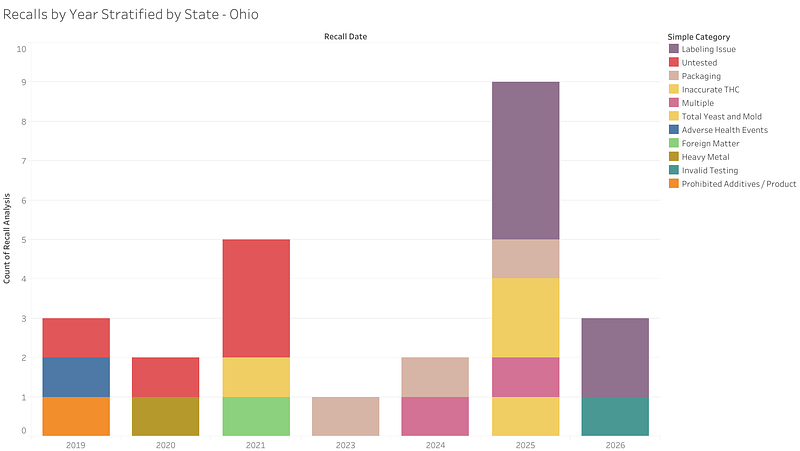
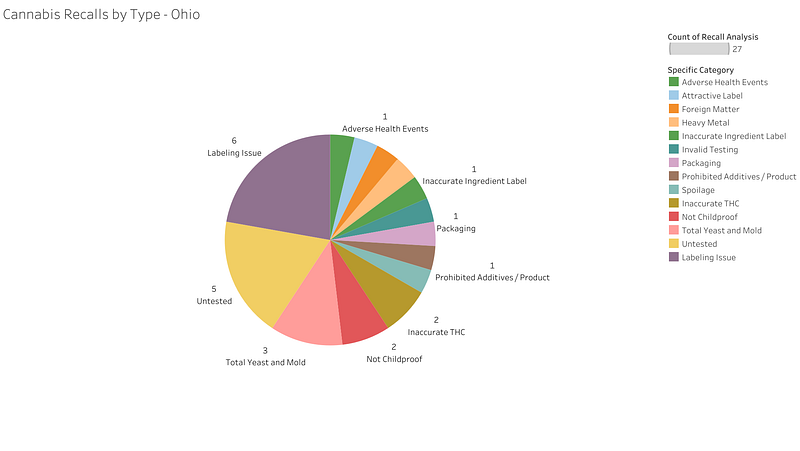
There’s a good enough mix of reasons where looking at them overall would be helpful, and we can see that the prevalent reason for recalls in Ohio is actually labeling issues (with untested product coming in a close second).
Oklahoma
Oklahoma has a great centralized repository of data about their recalls. It’s easy to access and contains all of the information that people need to identify cannabis products. If they wanted to step up their game, they could include photographs.
They have also been stepping up their recall efforts, with several more recalls in 2025 than in years prior.
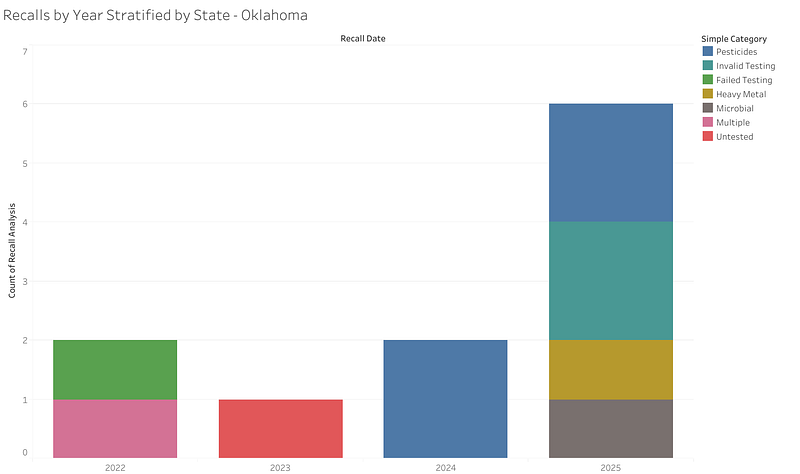
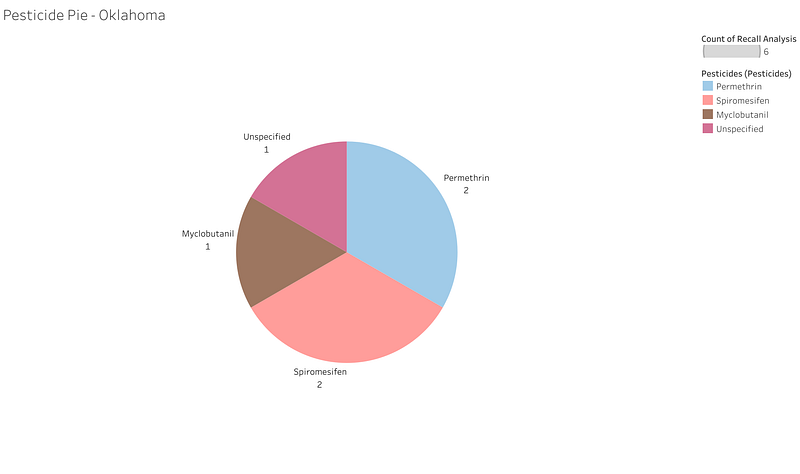
As pesticides are Oklahoma’s most prevalent issue, that means there’s a mix of them to look at, too.
Oregon
I have a special love in my heart for Oregon, of course, and they’ve had a long standing portal that they improve. It has images and more than enough information to identify products that may be impacted. YAY OREGON! Oregon, like other legacy states, has a lot of information for us to dig into as well.
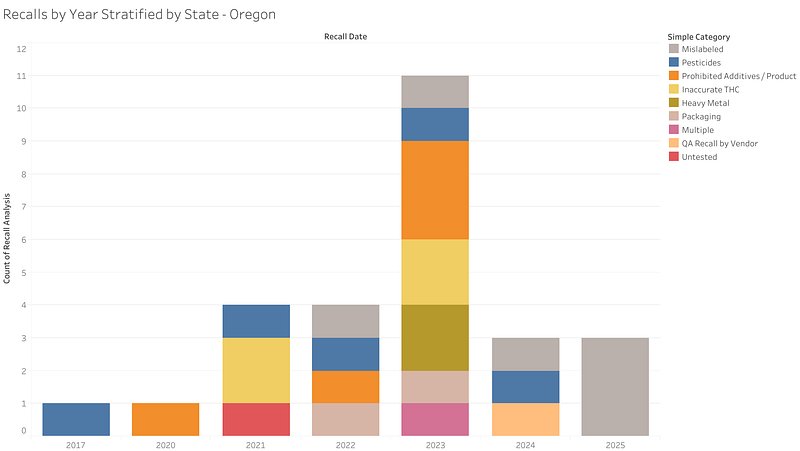
I am, of course, interested in the effective drop off from 2023 to present.
The most prevalent reason for recalls in Oregon has been due to Inaccurate ingredient labels, which I used to indicate when any ingredient OTHER than cannabis was involved (like allergens, etc.).
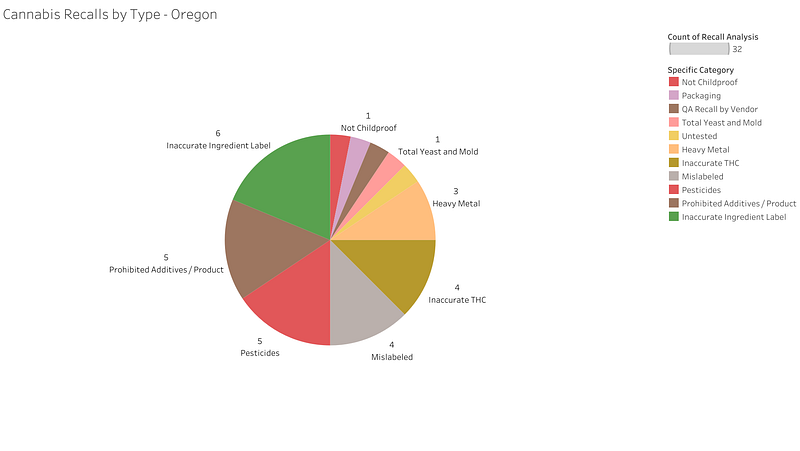
The pesticides that were found were Imidacloprid, Abamectin, piperonyl butoxide, and pyrethrins, but there were two incidents where the pesticide wasn’t specified.
Pennsylvania
Pennsylvania doesn’t have a centralized place to announce cannabis recalls, and the only one I can find evidence of was the enormous vape recall they did following the vape crisis. I’d love to see a state I spent so much time in (and still visit so frequently) to protect their citizens more meaningfully!
Vermont
Vermont had a massive recall with the Holland recall, and they include news about licensed businesses in a centralized place, but I wouldn’t say they are great at flagging recalls for consumers and citizens in general. I’m interested in a piece of news posted about a lost license and product that should be ‘treated as adulterated’ but isn’t a full ‘recall,’ but I’ve drawn a line in the sand around the idea of a recall reaching consumers.
Washington
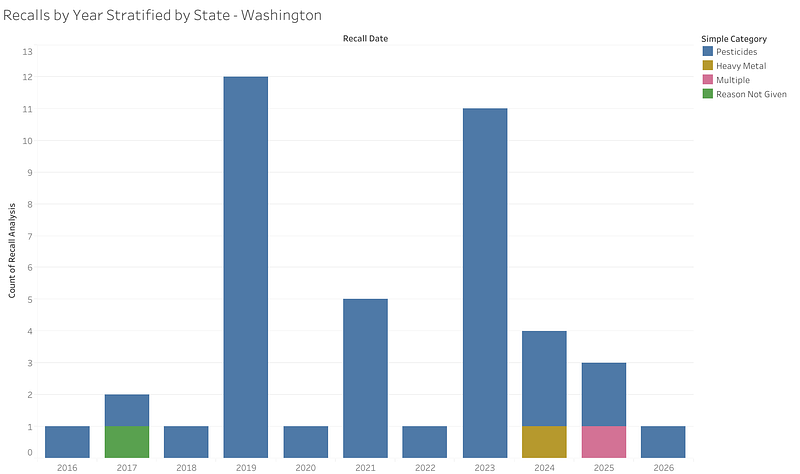
Washington is the home of the most delicious cherries I’ve ever tasted and some great cannabis data. This includes a good centralized place where their recalls are — my only gripe being I’d love to see more information about batch dates, and of course product pictures. But what I’d really love? To know more about the pesticides. Because looking at the data they present, the actual pesticides themselves are very rarely listed, and most of the time are unspecified.
Overall Analysis
Getting More Data — Needs More Data!
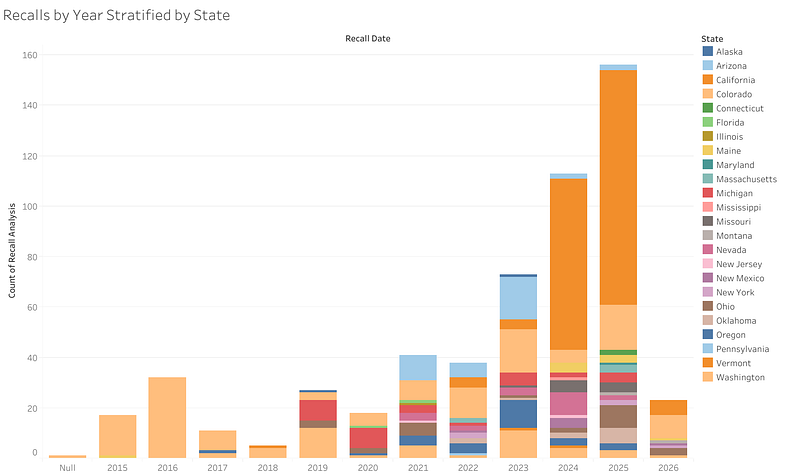
Obviously, there’s more data every year as more states present recall data and refine their recall programs.
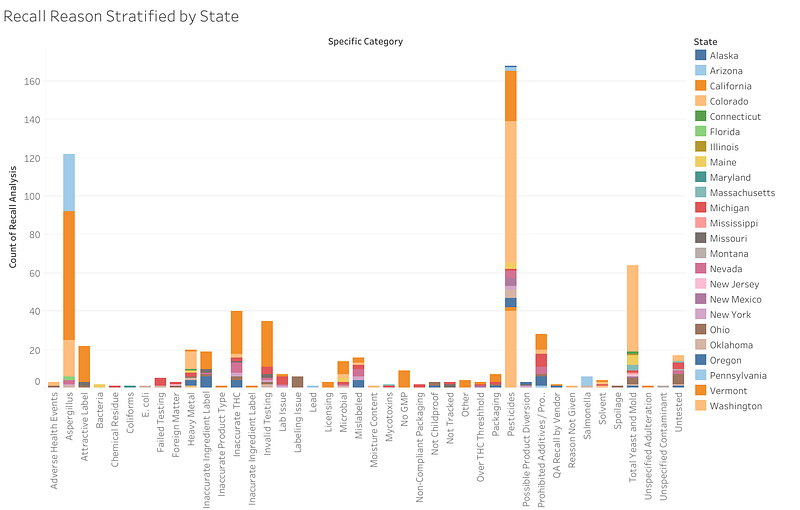
We also have a pretty good idea of why product gets recalled, with pesticides in the lead and Aspergillus catching up.
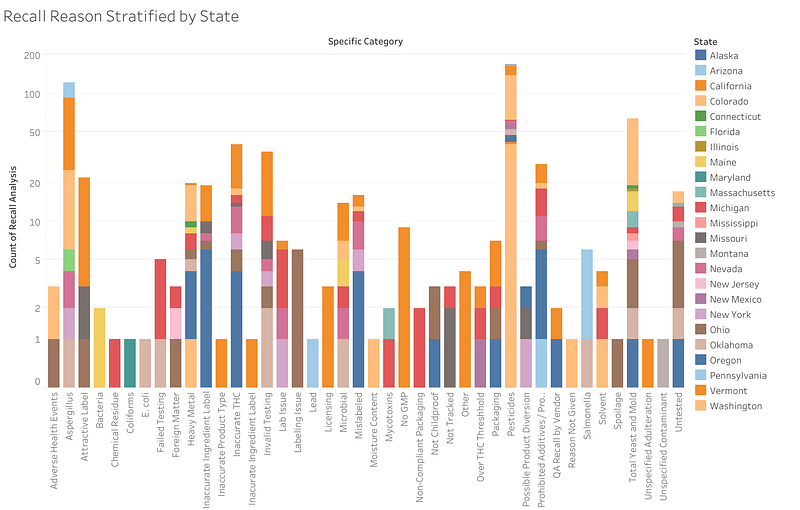
I’ve transformed that logarithmically so you can see some more of the nuance in the reasons and their relativity.
Pesticides
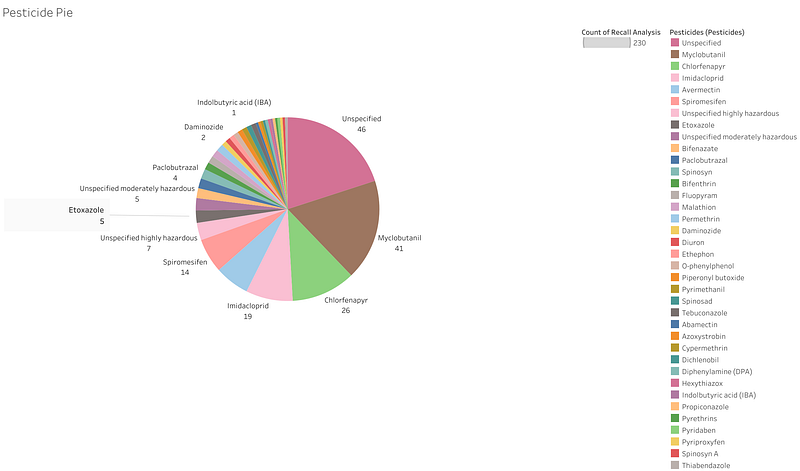
I once wrote an article about what pesticides were found in cannabis, and now we have a good idea of what pesticides are found in recalls. In fact, a very precise idea. Washington’s unspecified pesticides really impact us here — and it looks like cannabis runs on malathion.
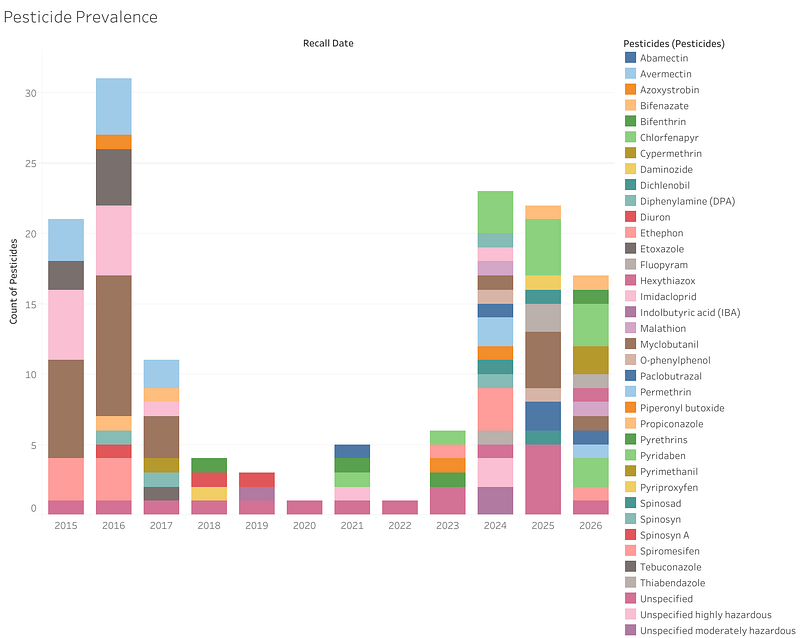
Pesticide Prevalence in the data set over time stratified by state also yields some interesting insights.
Recall Timing
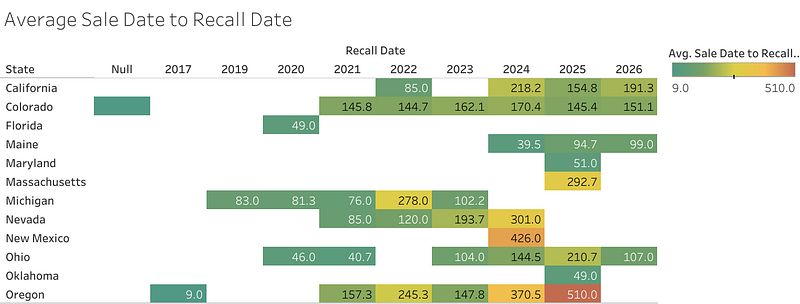
In instances where we’re able to see how long it takes a recall to happen from sale to recall because the state included the sale date, we can get an idea of how long each state takes (though the average is very sensitive to outliers).
Things Left To Do
I’ve given this far too much of my time already, but there are still things I’d do to improve on it. Here’s what I’d do (and what I’d have to invest time into if I do it again, because this thing should be in a database now and not just a spreadsheet).
Product Type Completion — I have some information recorded for product type, but I’m missing that information in 300 recalls because I didn’t capture it until this round.
Batch work completion — For the states where it’s available, I’ve captured batch by batch information (but not for the recent round of edits). I’d like to complete that work.
State by State recall scorecard — I have the information about what makes a healthy recall, it would be neat to actually put together a proper scorecard for it.
Actual Full database back end — it’s long past time I put this in an actual database instead of faffing around with a spreadsheet. The data capture expert / ETL engineer in me weeps.
Add in State Volume and Sales Information.
If I missed recall information in your state feel free to send me an email at jamietoth@protonmail.com .