Get to Know a Cannabis Terpene: Sabinene
This terpene has exciting medicinal benefits in addition to its spicy kick!
Sabinene was discovered by Dr F. W. Semmler , who published his findings in Schimmel & Company’s semi-annual report in 1901. Schimmel & Company was founded in 1829 in Leipzig, Germany as a botanical-based drug manufacturer named Spähn and Buttner, Schimmel & Company’s rose oil would help boost it to become the leading fragrance and flavor company in the world. In fact, they are still doing business today as Bell Flavors & Fragrances).
Schimmel was considered the leading fragrance company for around 100 years, and since Bell’s acquisition of it, they have undertaken efforts to preserve key assets (many of which are still in use), such as the company’s library. Undoubtedly that restored library contains the very semi-annual report published by Semmler in 1901, in which he identified and named “sabinene,” a hydrocarbon he discovered in savin oil which is created by steam distillation of Juniperus sabina. Savin oil is toxic and dangerous enough to be banned for sale in many countries.
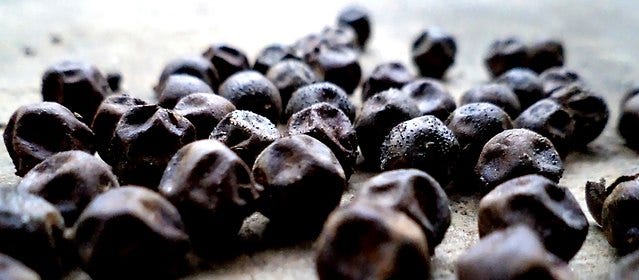
Sabinene, a bicyclic unsaturated monoterpene, is partially responsible for the spicy kick in black pepper and is also prevalent in carrot seed oil. Arctander’s Perfume and Flavor Materials of Natural Origin, a key perfumery text, describes the scent as “Warm, oily-peppery, woody-herbaceous and spicy odor of moderate to poor tenacity.”
General Uses
I think that gin at least deserves to make it to the list of general uses, as sabinene can be found in some varieties of gin, depending on the juniper berries used!
Its pleasing smell means that like many other terpenes, and the perfume industry uses it to as it’s useful to add light pepper notes.
Like many terpenes, it’s found in patents for CBD formulations . It’s also included in some cannabis strain applications.
And, like many other terpenes there are patents that include it in the biosynthesis of hydrocarbons.
Because of its scent, sabinene is included in a patents for things like perfumes and even one for ‘ coffee scenting,’which is worth a click-through — it’s a wild read, because it’s for “ The invention relates to a device and method for transferring an aroma from a aroma providing substance to a an aroma-adsorbing substance by a gas flow and without the aroma-providing substance and the aroma-adsorbing substance getting in direct contact. “
Medical Uses
Initial findings of a study found that sabinene was effective in fighting models of leukemia.
Sabinene’s antifungal properties can be observed in a variety of ways.
Sabinene and terpenine were able to additively impact leaf endophytic fungi.
Sabinene is present in tea tree oil, which has a variety of medicinal properties and potentials.
In Cannabis
Sabinene can be found in strains like Super Silver Haze, Super Lemon Haze. As with other terpenes, it’s vital to seek out products (flower and concentrate) with accurate lab information to ensure you are experiencing this exciting terpene.
Other Info
Boiling Point: 327.2°F
Other Sources: Pepper, Allspice, basil, norway spruce, carrot, holm oak, nutmeg, carrot seed oil, angelica, anise, bergamot, juniper, pimento, peppermint, pennyroyal, parsley, oregano, orange peel, nutmeg, marjoram,blood orange, boldus leaf, cardamom, cassia, celery, yuzu, yarrow, worwood, tumeric, thyme, tansy oil, tangerine, sage, mace, lime, lemon, lavender, hyssop, ginger.
Scents: Spicy-pepper, warm, woody, herbaceous, oily with some camphorous notes.
Flavors: oily, spicy, citrus
Article Sources:
https://pubchem.ncbi.nlm.nih.gov/compound/sabinene www.thegoodscentscompany.com/data/rw1056021.html https://archive.org/stream/annualreporto19211922schi/annualreporto19211922schi_djvu.txt https://en.wikipedia.org/wiki/Friedrich_Wilhelm_Semmler http://nadiaberenstein.com/blog/2017/12/7/avisittoschimmel https://www.compoundchem.com/wp-content/uploads/2015/04/The-Chemistry-of-Gin.pdf https://archive.org/details/ArctanderPerfumeryBook
https://pellwall.com/shop/ingredients-for-perfumery/natural-ingredients/essentialoils/sabinene/
https://pfaf.org/user/Plant.aspx?LatinName=Bunium+persicum
Originally published at https://oregoncannabisgazette.com.