How Tarot Has Helped My CPTSD
How I’ve used Tarot to Work Through a Dangerous CPTSD Symptom: Lost Intuition.
Trigger Warning: I talk about symptoms and causes of CPTSD and PTSD, and examine some mental and emotional abuse, but do not recount other abusive events themselves.
Over the past several years I’ve taken on the work of healing the deep wounds I’ve carried since childhood due to CPTSD. It’s hard work. There are a lot of specifics about what I’m dealing with that have made it even harder — specifically around my damaged memory. One of the trickiest things to work through is actually around intuition, which is why tarot has been so helpful to me as a healing tool.
What is PTSD?
PTSD, or Post Traumatic Stress Disorder, is caused by experiencing or witnessing a traumatic event. While it’s normal to experience symptoms and disruptions directly following a traumatic event, in the case of PTSD they linger for months and years. Symptoms include re-experiencing, avoidance, and sense of threat. The sufferer may go to extremes to avoid things that trigger these trauma responses. In children younger than six, the symptoms include reenacting the event through play, or nightmares. A more complete list of the symptoms of PTSD and its diagnostic criteria can be found here.
PTSD is not experienced by everyone who has witnessed or experienced a traumatic event. Some research indicates that the onset of PTSD is at least partially determined by the presence of interpersonal violence, as it doesn’t present as frequently in those involved in accidents and natural disasters. The Journal of Traumatic Stress stated, “In univariate analyses adjusted on gender, six events were found to be the most significantly associated with PTSD ( p < .001) among individuals exposed to at least one event. They were being raped (OR = 8.9), being beaten up by a spouse or romantic partner (OR = 7.3), experiencing an undisclosed private event (OR = 5.5), having a child with serious illness (OR = 5.1), being beaten up by a caregiver (OR = 4.5), or being stalked (OR = 4.2)” [OR = odds ratio] ”
What is CPTSD?
CPTSD, or Complex Post-Traumatic Stress Disorder, is caused by long-lasting, repetitive exposure to trauma from which there is no discernible escape. It’s caused by things like childhood abuse and neglect, torture, and war imprisonment. It is not yet recognized in the DSM-V, but many believe it should be. While CPTSD shares 3 symptom clusters with PTSD (re-experiencing, avoidance, and sense of threat), it also has three additional symptom clusters: affect dysregulation, negative self-concept, and difficulties in relationships.
CPTSD is often manifested in those abused by a carer.
How CPTSD Impacted My Intuition
When I was growing up, I couldn’t acknowledge how I was being abused — to do so meant I’d be hurt. There was also no escape — my abusers controlled me, knew everything about me, and had access to me any time they wanted. The abuse wasn’t just physical. When I would get too out of line they’d tell me I was such a horrible person that I deserved my mother abandoning me, and I was lucky I had them. To avoid the pain of hearing that, I internalized their criticisms. In his book, Complex PTSD: From Surviving to Thriving: A Guide and Map for Recovering from Childhood Trauma, Pete Walker goes into depth about this inner critic, and the severe damage it’s capable of doing to those suffering from CPTSD. Exactly as he described, I would chastise myself for thoughts that what was happening to me was ‘unfair.’ Because I had to believe their version of events, I gaslit myself so I’d never step out of line.
I was constantly examining my flaws, lit by that internalized gaslight.
When I was being abused by the people who were supposed to care for me, listening to my intuition, which told me to run or react in any other way, would result in more abuse. It took until college for me to understand just how bad the abuse was, and it took another decade still to realize that I had been damaged by that abuse, and still more time to realize how extensive the damage was. I began to read about it, once I could admit that I had PTSD. Books like ‘The Body Keeps the Score’ by Bessel van der Kolk helped me understand the sorts of things I was up against.
I started realizing just how much of my personality was just constructed by my reaction to and relationship with trauma. My hyper organization and perfectionist drive my old hierarchical corporate job? Trauma. Abandonment issues? Trauma. Issues with Authority? Trauma. Deep empathy? Believe it or not — trauma.
It’s taken me until my mid-forties to recognize how extensive the impact of healing can be, too.
When I’m not dysregulated, I can be a comforting and soothing presence. I can give space to people’s deepest motivations, insecurities, and fears so that they can think through an issue in ways that many untouched by trauma can’t. Years of making decisions under stressful situations have made me a natural brainstormer. Because of all that catastrophizing, I’m amazing at planning out alternative solutions and ways that a plan might fail to ensure it will succeed.
It used to be every time I found out that some other personality ‘quirk’ of mine was a trauma response, I would just be sad and depressed. I’d then berate myself for feeling sad over ‘nothing’, which would turn into a hate spiral that would trigger a more spirited barrage from that inner critic.
Now, sometimes, I can stop all of that and allow myself to grieve, and recognize the normalcy of doing so. On good days, I can even laugh at how utterly horrible what I lived through was. Or how cartoonishly villainous someone has to be to make a child hate itself, possibly forever. (is that me catastrophizing, which is another trauma response?). Sometimes I can even laugh at how hilariously typical my trauma responses can be.
What Does Tarot Have to Do With All That?
The archetypal imagery and symbolism in tarot give it a system that is ‘reliable.’
Let me tell you — as someone with abandonment issues, I seek something reliable.
When my thoughts and feelings don’t feel stable or regulated, tarot helps ground me and empowers me by reminding me that these things transcend me and are part of this human experience. They remind me of what I’ve seen before. Because there is a sensible structure to tarot, I feel more guided and less alone.
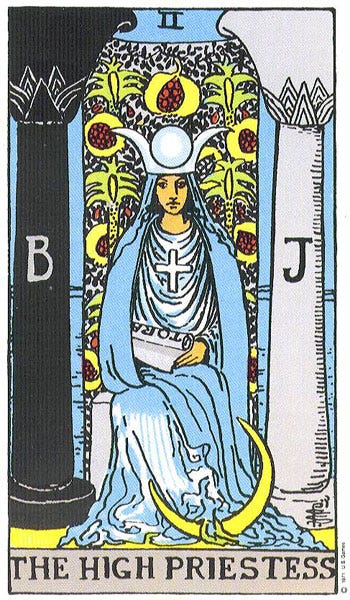
Card meanings relate to a variety of things, and card meanings transcend decks, which has made Tarot a regulating and stable figure in my life where there is none. While The Hermit may be slightly different from one deck to the next, the meaning of the card is relatively stable across all of them. I may have unstable relationships with others, but my relationship with the High Priestess is a long and ever-evolving one.
Long contemplation of tarot archetypes relieves some of the loneliness that can accompany CPTSD. It makes me feel less alone to see moments and people that I’ve known in these cards. It’s a way for me to connect to these stories, and ultimately other people. Humans have been having these experiences of love, loss, intention, and hope for years.
Tarot allows me to connect to those human experiences and human stories when a connection to the humans themselves would be too much.
For me, the most intuitive engagement and healing come through working with spreads of cards, as I try to ‘feel’ how that card relates to its position in a spread (or to the person I’m working with).
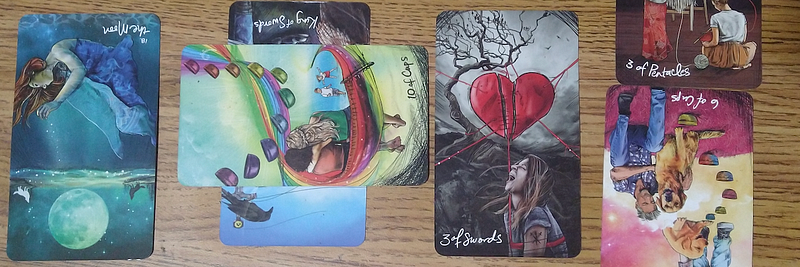
My favorite spread lately has been a three-card spread that Darren created that I call “Where’s Your Head At.” Since it’s three cards: One that represents you (‘Where’s your head at?’), one that represents the world, and one that represents advice/challenges. I like a three-card spread like this because it’s not as emotionally taxing as doing a larger spread, and is manageable enough that I can practice it every day.
Tarot readings for others are another way I’ve used the tarot to heal my intuition. In working with people I know and trust, I’m able to use the cards to relate to them and their experiences. As we talk through the cards, their meanings, and positions, I am helping connect them to their intuition, which in turn helps me connect to mine.
When all of that is too much, even meditating on single cards helps to reconnect me to those primal concepts and feelings represented in the cards.
After years of working with tarot alongside my trauma healing work, I’ve used the cards to create an access ramp to re-regulating my emotions and a way to reconnect with my intuition.
Sources / Further Reading
DSM-V Description of PTSD: https://www.ncbi.nlm.nih.gov/books/NBK207191/box/part1_ch3.box16/
https://www.verywellmind.com/what-is-complex-ptsd-2797491
https://mural.maynoothuniversity.ie/11577/1/Hyland_Review_2017.pdf
https://www.tandfonline.com/doi/full/10.1080/20008198.2017.135338
https://en.wikipedia.org/wiki/Post-traumatic_stress_disorder