Is Oregon’s Cannabis Over-tested and Under-safe?
If the Oregon Liquor and Cannabis Commission Has to Recall Product from the Shelves from Over A Year Ago, How Effective is Monitoring of…
If the Oregon Liquor and Cannabis Commission Has to Recall Product from the Shelves from Over A Year Ago, How Effective is Monitoring of State-Mandated Testing?
After months of listening to a variety of experts on the subject, I believe that Oregon’s cannabis testing, as it’s performed now, creates a product that is paradoxically both over-tested and under-safe. The stories I’ve been writing are around fraud and over-reporting of THC potency using state data to examine trends, and homegrown proficiency testing
This one is different.
Two weeks ago, the Oregon Liquor and Cannabis Commission (OLCC) released a bulletin regarding a recall performed on cannabis concentrates. Since publishing that article on the recall, I pursued information from the state, producers, and the lab on what really happened in an effort to understand where consumer’s concerns should be.
What I Know — And What I Don’t
The OLCC news release about the recall itself is sparse on information, and the investigation which started on November 29th is ongoing. The state had to update their news release twice — once at 8PM that very night, to absolve the lab involved in both products of wrong doing, and a second time several days later to update labels that were illegible (that second time was my doing).
Regardless of the strange timeline and spare news release, implications of the discovery are distressing. In an environment where taxes are paid to ensure that products are tested and the results are sent to the state, how can such a failure happen?
The news release states that the products were identified using the Cannabis Tracking System. I’m unsure as to whether that means they were identified as possibly being contaminated by the CTS, or if that means they were able to trace the batches to the shelves.
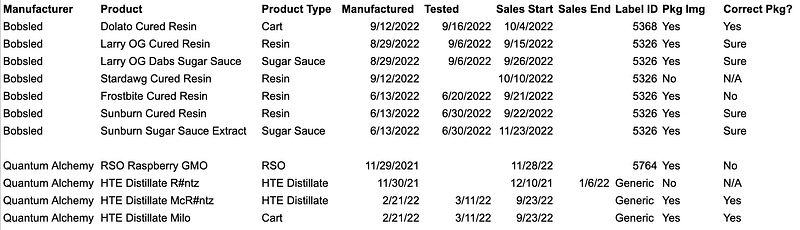
When I put all of the information together, it was clear that the recall involves 11 products. The dates of manufacturer are from November 28 2021 (Quantum Alchemy GMO) until days before the investigation started.
There’s some other interesting information to be gleaned. For a news release regarding a recall, very little information was supplied about where the product was available for sale. Of the 11 products listed, only 3 had the exact packaging available in the recall represented. On Oregon’s recall page, the HTE Distillate Vape cartridge isn’t mentioned as being a vape cartridge.

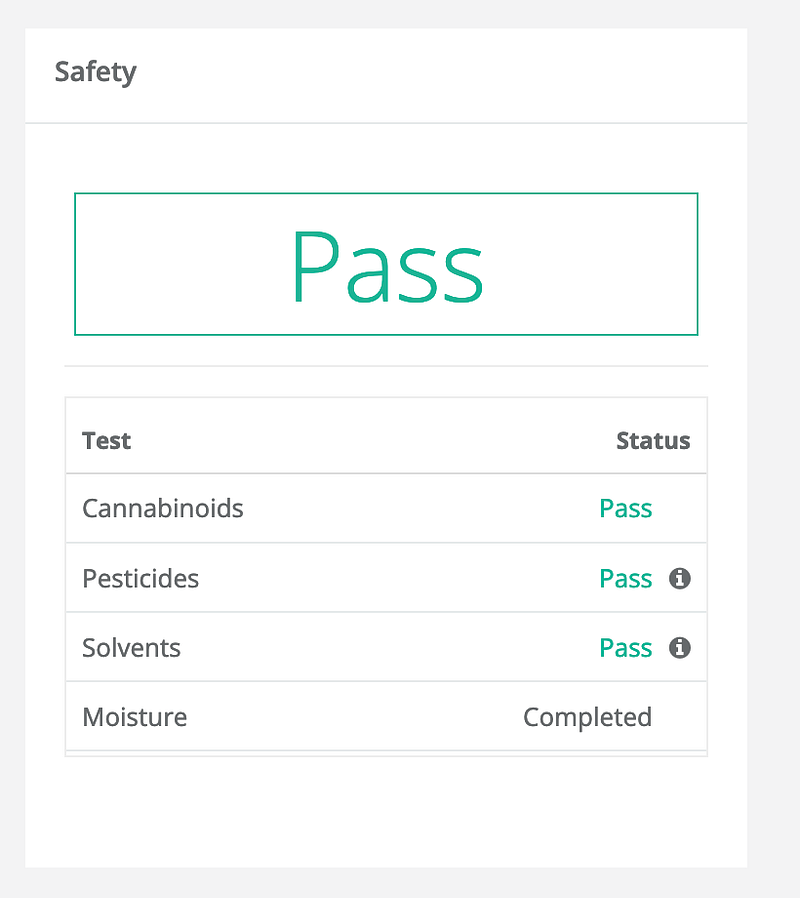
After I published the last story, I was put in touch with one of the producers, who sent images of their CoA’s with a pass on pesticides. I don’t want to go into a lot of detail other than the fact that the producer did not initially reach out to me — someone mutual did.
The producer actually emphasized that they had no interest in starting issues with the OLCC. The mutual contact was the one that put is in contact to be sure my story was correct, and informed me that the products that were recalled by the state all had passing CoA’s.
I knew that.
In Oregon, it “isn’t possible to put products on dispensary shelves that don’t have a pass on pesticide tests.” I put that in quotes because nearly all the rules in Oregon have a way for Bad Actors to circumvent them.
From the producer’s point of view, their product is involved in a recall even though it passed state mandated tests.
When I approached the state with the information that I had a copy of a passing CoA for some of the product, and had a variety of questions about the farms and exact pesticides involved, I was informed that the state’s investigation was ongoing.
Chain of Custody
“Chain of Custody” is a nice way of saying that samples should have a clear lineage of where they came from. When I started to learn about testing in Oregon, I mistakenly thought that there was a very clear chain of custody.
In the world of healthcare, the one I came from, we were very careful to maintain a chain of custody on lab samples via a web of scannables, databases, and frequent checks in the SoP’s. I thought that with METRC tags, etc. that cannabis would be similar, and that the samplers from the labs scanned or acknowledged the agricultural batch from whence the testing materials came.
That’s not what happens.
When a lab sampler shows up, their customer (the farmer or the producer) presents them with material to be tested. That material could, indeed, be from the flower, slab, or oil that the manifest was created for — or it might not. There are some in the industry that contend that concentrate producers, in particular, have a ‘clean slab’ that they use for testing that will test high on cannabinoids and free and clear of pesticides.
Without off-the-shelf testing to confirm what products are hitting the shelves, testing is at the whim of the tested — and contaminated product could make it to the shelf. All the producer has to do is present their testing slab, and then send the actual product to the shelf once the tests come back clear.
Remediation?
An Oregon producer claimed that the issue might have to do with remediation tactics.
Oregon has an extensive list of pesticides to test and that list is positively worthless if it can’t be monitored effectively. For flower, ‘remediation’ is ’pretty straightforward.
For extracts, things are a bit more nuanced. To make things just another level of tricky, extract material that might have pesticide or other contamination can be easily diluted into other material to pass state standards. More than one producer has told me they find it troublesome that METRC allows for them to do things that they shouldn’t be ‘allowed’ to do (a complaint I frequently heard from doctors about the Electronic Health Record ‘allowing’ them to prescribe incorrect medication doses).
Where’s the Media?
When I reached out to several outlets about the THC potency issue, including with graphs and data that substantiated my claims, I was surprised at who didn’t write about it.
This recall story is the same. I’m surprised at the number of people with larger platforms and more meaningful resources than I have who aren’t talking about this.
Let me say it plainly: This recall is another troubling indicator that the way we are performing lab testing isn’t actually making cannabis safe.
The message to consumers is clear. You’re on your own to find producers, extractors, labs, and dispensaries you trust — and all you can do is hope they are trustworthy.