Meditating On The Smith-Waite Tarot’s Stage Cards
The stage cards present an opportunity to meditate on when a moment feels like a performance.

Each tarot deck has its surprises and complexities. Pamela Colman Smith’s tarot deck has many such gifts to card readers. Included among these tarot ‘Easter Eggs’ are the ‘stage cards,’ cards that appear as if they happen on stage. The fact that all of these cards show people who seem to be separate from their backgrounds can offer additional aspects to contemplate when using the tarot as a meditation tool. These cards are entirely a minor arcana phenomenon, but an interesting one! To understand why a stage, let’s get to know the artist.
About the Artist
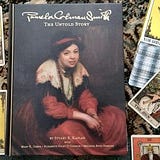
I’m not going to be able to do her justice here, but the bare minimum of the facts are that Pamela Colman Smith (1878–1951), nicknamed ‘Pixie,’ was born in London to an American merchant whose job took his family from London to Jamaica frequently. Her mother was Corinne Colman, sister of painter Samuel Colman. There are many who believe to be biracial, with one of her parents being Jamaican.
When she was 15, Pamela Colman Smith moved to New York City and attended Pratt Institute. Her mother died in Jamaica and Pamela left school to return to Jamaica before completing her degree. One of her first post-school illustration projects was The Illustrated Verses by William Butler Yeats. It was during this period she also illustrated some Jamaican folklore books. She also began to tour with the Lyceum Theatre Group to illustrate a book by Bram Stoker about actress Ellen Tracy. She traveled with them and did set design and costumes in addition to working on her illustrations. It was the theatre group who would give her the nickname ‘Pixie.’
It was Yeats who would introduce her to the Hermetic Order of the Golden Dawn, which is how she met A.E. Waite. The order split, and Smith moved with A.E. Waite to the “Holy Order of the Golden Dawn.” In 1909, A.E. Waite would commission the tarot deck, with the intention that it would appeal to the art world. The deck gained the moniker “Rider” from the fact that the printer was named Rider. Waite himself commissioned the deck, but it was Pixie who brought it to life with illustrations overflowing with symbolism and archetypes. After learning all of this, it’s so sad to remember how long the deck was known simply as “The Rider-Waite.” I’m so happy to call it the “Smith-Waite.”
The Stage Cards
Unlike designations like ‘Major Arcana’ or ‘Minor Arcana’, stage cards aren’t always agreed upon. The general rule is that the stage cards can be identified by a double line that goes across the card, separating the figures from the background.
I’ve seen a bunch of different lists for the stage cards, and here’s mine.
Cups
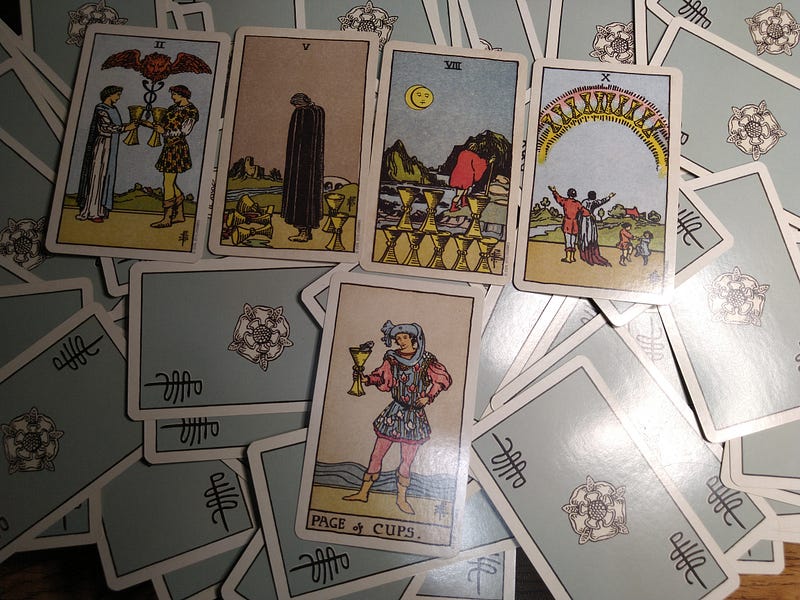
The largest list of stage cards comes from the suit of cups. It also contains my controversial pick because the double line on the eight is arguable, but I stand behind it.
Wands
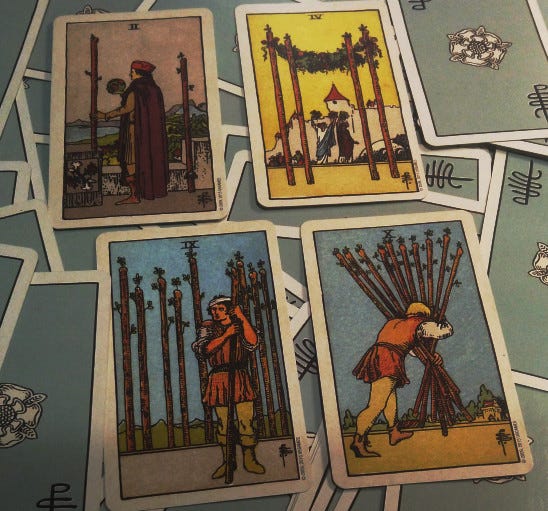
Two, Four, Nine, Ten.
Pentacles
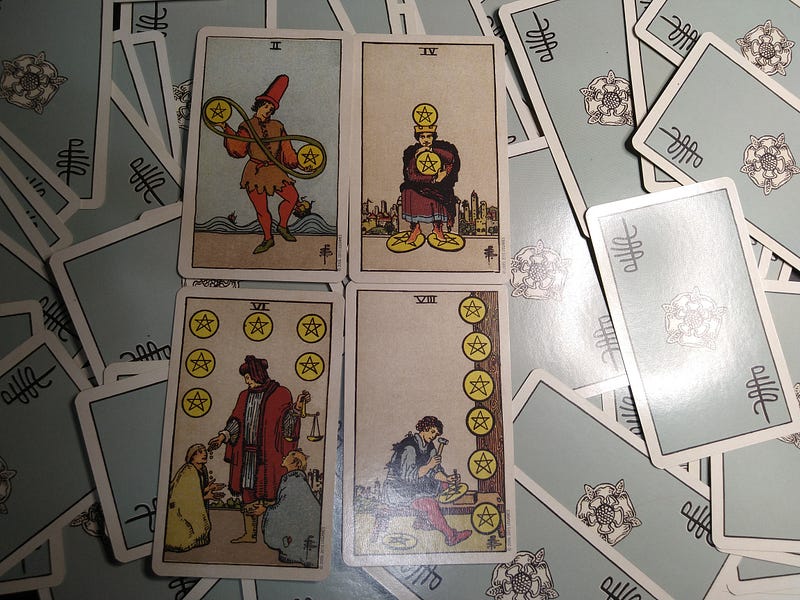
Two, Four, Six, Eight
Swords
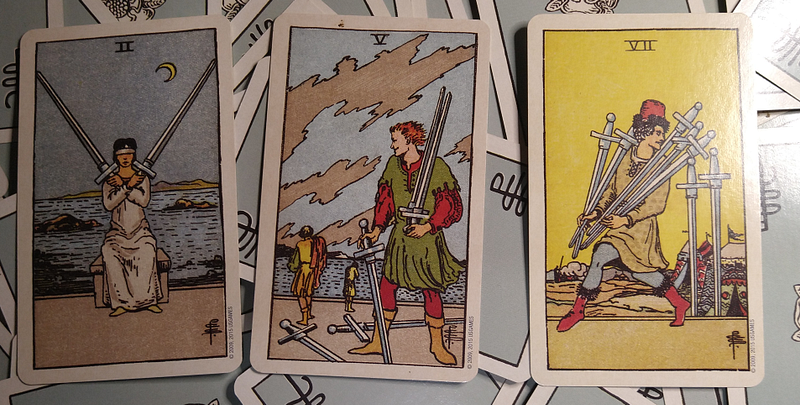
Two, Five, Seven
Stage Cards In Other Decks?
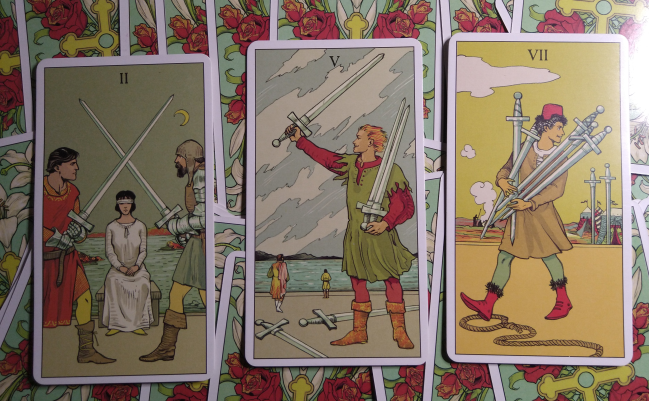
While the ‘Tarot of the New Vision’ deck is based on the Smith-Waite deck, it doesn’t have any stage cards among its depictions. The After Tarot is consistent in the stage card depictions as they are found in the Smith-Waite deck itself. These cards show the moments depicted in the Smith-Waite deck one moment after. Largely waiting a single moment doesn’t change a huge amount of the meaning of the cards, but sometimes, it does (take a look at what’s about to happen to that thief in the seven — the physical duel about to take place is an interesting twist on the two).
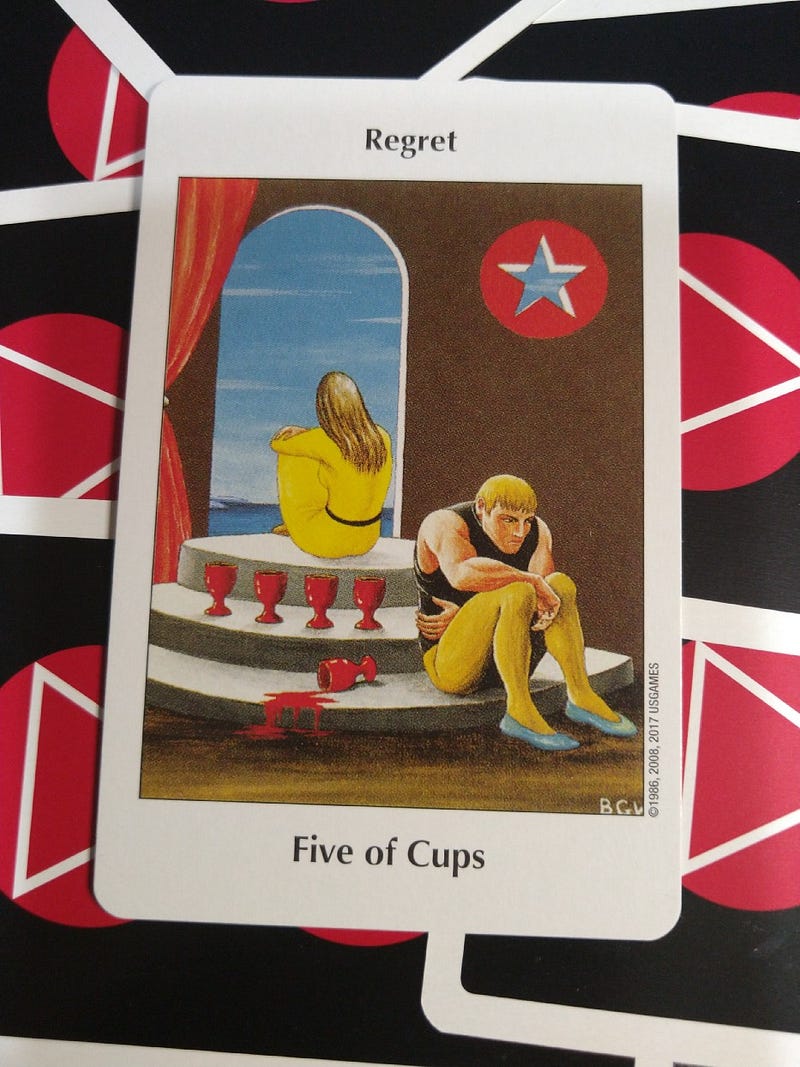
I also found a slight parallel in Barbara Walker’s Five of Cups. In this card, both figures are on a stage. They are separate from each other, the room they are in, and the sea outside of the window. The ‘stage’ they are on shows they are on different levels entirely, in addition to being separated by the cups (the well of their emotion).
Like the stage cards of Pamela Colman-Smith’s deck, this card really shows how separate these characters feel from each other, but I don’t feel that this is a stage card in the same way that I find those in the Smith-Waite deck compelling.
Meditating On the Stage Card: What Could It Mean?
When I see stage cards, I meditate on how a ‘stage’ could impact the card’s meaning. Could it be that someone is putting on a show — as in being performative or even straight up lying? Is it indicating that the person is separate from their environs? Is there anything in the cards around the stage card that would indicate this is so? Is there something about the situation that leaves me feeling separate from my environs?
Is there a moment that feels like a performance, or feels like I have to put on a show?
Notable to me is that all of the twos are stage cards. Twos are cards of balancing the opposing nature of creative forces, of its dual nature.
It also seems notable to me that of all the numbers, only 3 isn’t represented among the stage cards. Threes in the tarot often are representations of collaborations, groups, creation, self-expression, or growth. It seems that when trying to determine how to deal with stage cards, that understanding that these states of being are not on ‘stage.’ Perhaps this also indicates for the stage cards that they are instances in which some feel called to ‘play a role’ or to ‘put a brave face on things.’
Also entirely missing are Aces, though this isn’t a surprise. There is nothing performative about Aces, as they are a primal, pure representation of the suit. Also missing entirely are the Major Arcana — those cards represent moments of enormous weight and energy that would eclipse a stage.
For the court cards, the only card included in the stage cards is the Page of Cups. When reversed this card that normally means messages of connection can often indicate deception instead.
But these cards, like the extra cards in other decks we’ve discussed, remain a special gem to the Smith-Waite Tarot. The stage cards give us a chance to contemplate the ways in which we are compelled to play roles within our own lives, when things might be performative, or when there might be deception about — whether internal or external.
Article Sources:



http://www.johncoulthart.com/feuilleton/2009/07/11/the-art-of-pamela-colman-smith-1878%E2%80%931951/