Meditation on Manifestation: The Magician
Meditating on the tarot’s Magician is a way to understand our power of manifestation.
The major arcana of the tarot document the Fool’s journey into the World, and the Magician teaches the first lesson the Fool must learn in order to progress. This primary lesson is in manifestation.
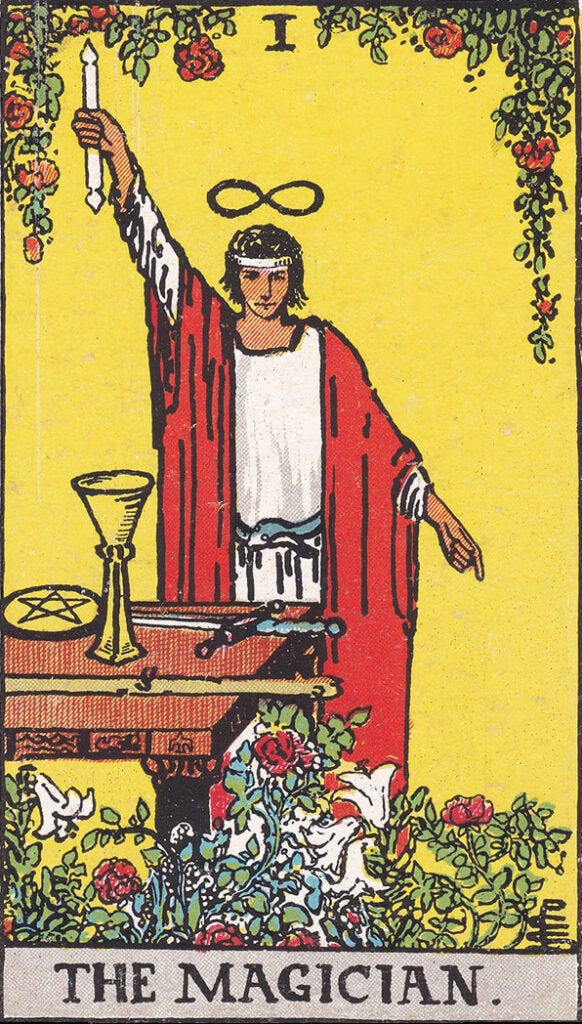
In the Smith-Waite-Rider deck, the card depicts an enrobed figure with one hand outstretched and raised, pointing to the sky, and the other pointing towards the ground. The white tunic they are wearing symbolizes the purity of the soul, and the red robe is passionate, mortal flesh. In front of him, there is a table with the physical manifestations of the suits. The lemniscate is above his head, and red roses and white lilies spring from the verdant garden surrounding him. This points to his limitless creative abilities. A phrase often associated with this card is ‘as above, so below.’ The Magician understands how to act as a conduit between the realm of the possible and ours. The Magician represents the ‘divine motion in man,’ meaning our ability to visualize and create — the Magician is the conduit for the divine motion of creation.
The Magician speaks to our innate ability to create — it is a natural skill. The Magician’s ability to channel the higher energies into creative output is to remind us to focus obsessions and interests to create what we want here on earth. The Magician is the master of these skills.
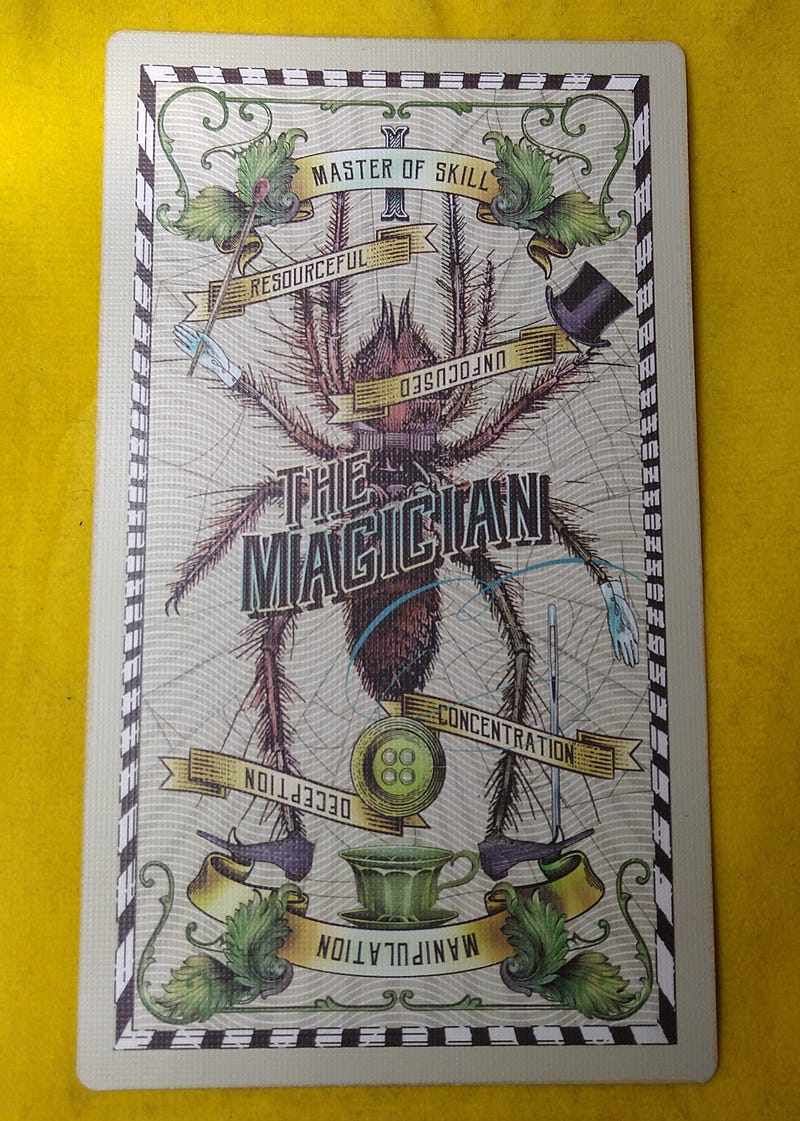
The Five Cent Tarot uses the Spider for The Magician, and I love that choice. It reminds me of a passage from the Upanishads that says, “We are like the spider. We weave our life and then move along in it. We are like the dreamer who dreams and then lives in the dream. This is true for the entire universe.” The Magician is a reminder that we (the querant/reader) are the ones with the true power: the power to manifest. We are all capable of dreaming dreams, and there is a Magician there within us all.
Creative power is not the only power of the Magician — on the table before them are physical manifestations of the tarot’s suits. The “Afterthoughts” book, the book included with The After Tarot, adds that in their deck, the hand in the Aces of the suits is the hand of the Magician (in many other traditions it is ‘the hand of the divine.’).
My early tarot teachers stressed that tarot cards didn’t ‘divine’ the future as much as they laid bare what the querant thought about the future. It’s like a coin flip. Sometimes the power of a coin flip isn’t in the relief of having ‘fate’ decide for you — but in knowing what you think of one of the choices. Once the coin flip lands, that feeling you have in your gut is a way to realign yourself with your intuition.
The Magician card originated from the tarot game, in which the card represented a sleight-of-hand magician or street magician, which was only one step up from ‘The Beggar’ in terms of trumps. The reason I find this interesting is that the implication of the Magician as a confidence man vs. a conjurer gives an interesting spin on their abilities. Not only are they able to manifest things into reality: but they are also able to make people see images (illusions) they create. Sleight-of-hand artists understand the power of attention and misdirection: much like a conjurer does.
Knowing what you want can be an difficult part of creation. The focus, conjuration, and mastery of The Magician card is vital to The Magician’s ability to manifest and create.
The Magician invites us to consider that the tools to manifest what we want in the world are at our disposal if only we have the discipline and focus to know what we want. That ability to focus, channel, or be a conduit for ideas only works if there is an idea with which to start. That’s why, when the Magician is reversed, it indicates an inability to focus or harness those abilities. It indicates that the Magician, who is used to processing their world using the power of creation, can feel lost without that all-important vision. The Magician teaches the fool that it is more than just the energy of creation itself, but also takes an ability to understand how to blend that vision with the resources at hand to get the desired result.