Meditations on the 10 of Wands
What I think about, when I think about the 10 of Wands.
For a two-week streak in 2015, I drew the 10 of Wands in my daily tarot draw. Every single day. I would change decks and still, there would be the 10 of wands. One day it would be right side up. The next, upside down. Then a streak of right side days, followed by a streak of upside-down days — you get the idea. I kept it to myself, of course, which is exactly what you’d expect out of someone drawing that card.
At the time of this little tarot-magic twist to laws of probability, I was overloading myself (while still appearing quite successful on paper). My job was a complete nightmare, and the only way I could deal with the feelings it was evoking in me was to pick up a distance running habit that was broke me down mentally and physically. Drawing a card that is emblematic of the many dynamics of struggle in that particular time of my life was no real surprise — what was the shock was the sheer frequency.
The tarot was flashing a card that is supposed to indicate a time to take stock — and it was doing so in earnest.
As this is a card from the minor arcana it’s important to consider its placement and suit. Ten in the tarot, and in many other places, is the number of completion and indicative of the end of a cycle. The suit of wands is connected to fire and symbolic of human creativity and will. When I think about the suit of wands, not only do I think of creativity and willpower, but also passion, spirituality, and personal growth. As a fire sign, I’m particularly sympathetic to the situations and energies presented within the wands.
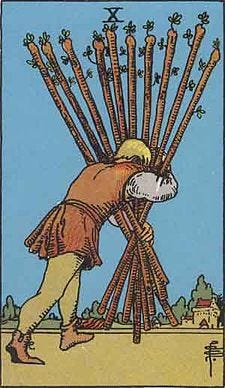
In the traditional RWS tarot deck (shown above), while the figure in the foreground is hard at work, the village and their destination is within striking distance. Except the figure, the one hauling all those wands, can’t see how close they are (those damn wands are in the way!), and they are fully engaged in the task of getting this burden to where it’s going as if there is no need to see ahead when the only task is the doing. The foreground of the card is about the person hauling this mass of wands, but the card also invites us to understand just how far they’ve come on their quest, and how very close they are to completing it. This is the culmination of will — that last push to completing a mammoth task. This card also shows how the figure has chosen to carry the wands is working against them — this is a situation of their making. This is punctuated by the clear blue sky and the lack of others within our frame of view.
It’s also important to note that the 10 of wands is one of the ‘stage’ cards in the RWS tarot. Colman Smith was active in the theatre, and there are several cards where the action is pictured as happening on a stage (as indicated by a double line), and that the action is not actually taking place within ‘the real world.’ There is a lot of speculation in the tarot community about what these stage cards mean, and if there is a code. The ‘stage’ interpretation as the action in the card being ‘played’ as opposed to being lived brings new life to some of the cards (10 of Cups, for instance, takes on some far different implications when you place the action on the stage, as does the 10 of Wands).
Studying the artwork across decks for the 10 of wands, the commonality is that they focus on the oppressive burden more than the nearing completion of the goal. Some show acknowledgment by the wand-bearer of how near their destination is and others don’t. What is clear across all of the decks is that the 10 of Wands represents an oppressive task — that it’s time to take notice of how you are managing it, and whether or not you should seek assistance or delegate.
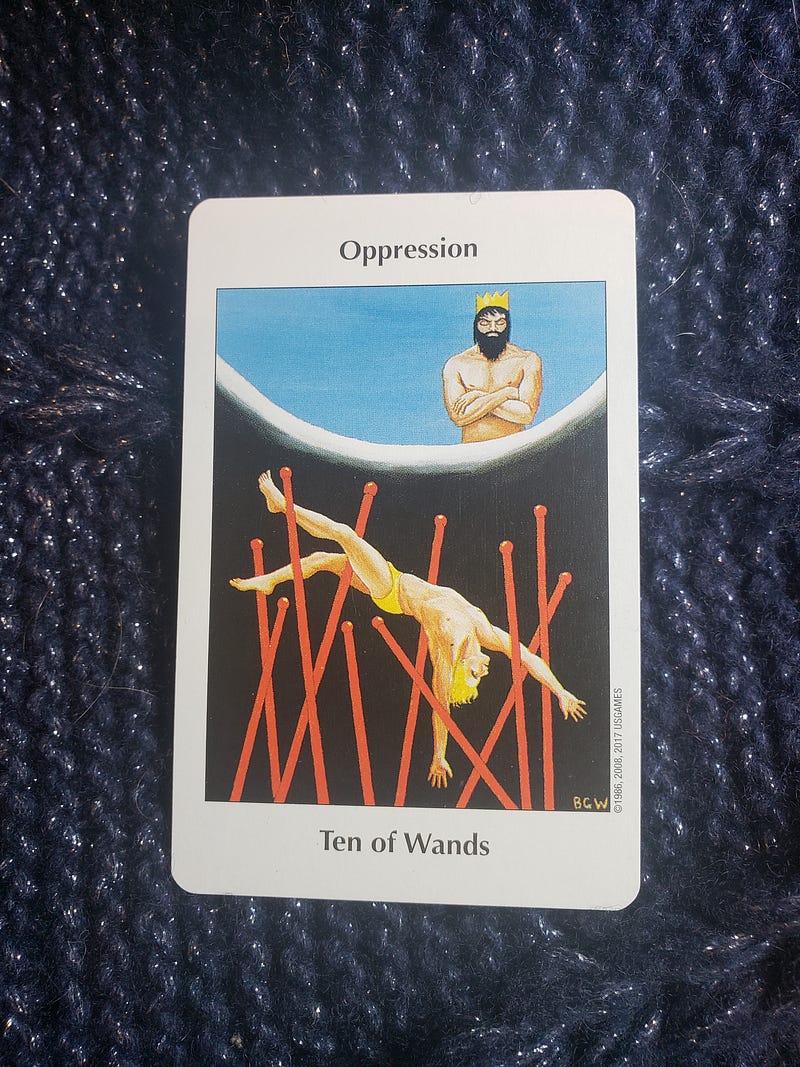
I love Barbara Walker’s Tarot for many reasons, one is that she wrote some of my favorite knitting references, and another is that the artwork and symbolism in her cards is fascinating and evocative. In her deck, the 10 of Wands gains the descriptor of “Oppression.” Walker’s deck utilizes stories of various deities from several cultures for its symbolism and art inspiration. In her companion book to the deck, Walker states that the card is a reflection on Lucifer, the Light-Bringer, who was particularly revered in Gnostic Christian sects. The card depicts the defeat of Lucifer. It asks us to contemplate how the Gnostics viewed the corruption of God’s power in this act — that if a god carries absolute power, then that god is corrupted absolutely. In Walker’s deck, the 10 of Wands is the ultimate culmination of power and represents power’s ability to corrupt, oppress, and destroy. Here, the notion of a burden has more depth than that of a task fulfilled — it is emblematic of the final, corrupting culmination of power.
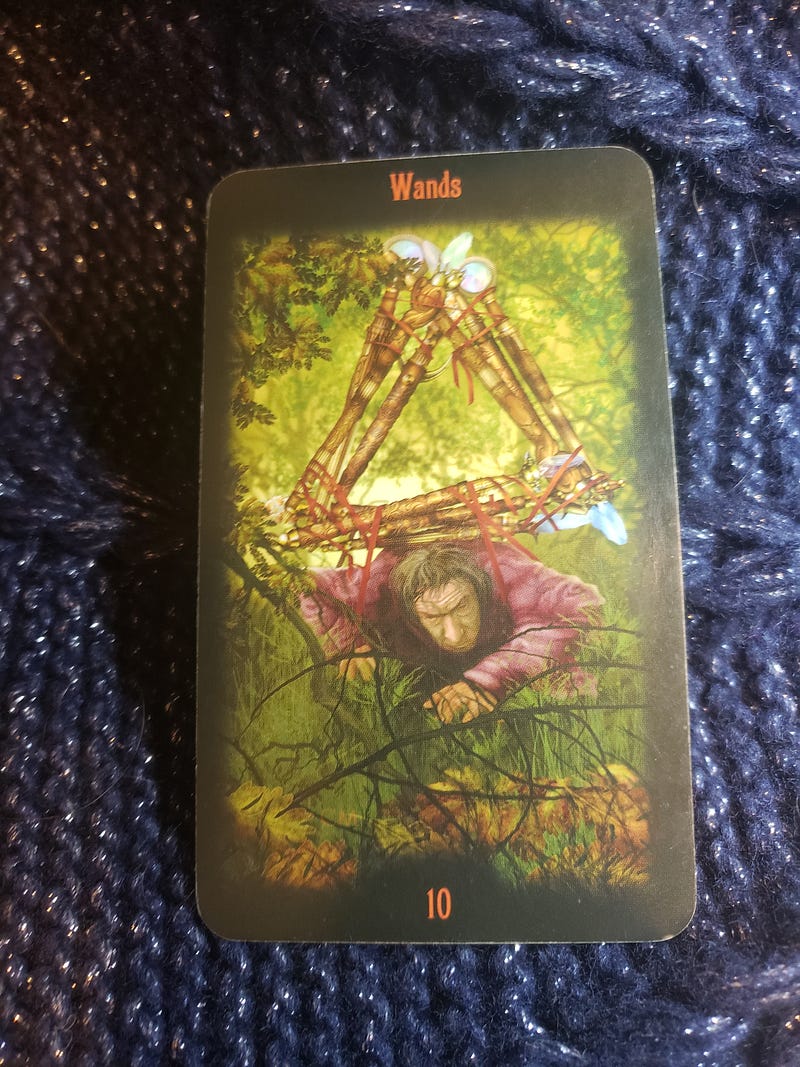
Other decks focus on the will of the person in the card. The Legacy of the Divine Tarot by Ciro Marchetti shows just how worn down yet determined the character is in attempting to reach their goal, 10 divine wands strapped to their back as they crawl on their hands and knees through thick vegetation and vines. Marchetti’s card highlights the burden and the struggle for the goal.
While the 10 of Wands can be a tricky one to reconcile in the context of the reading, contemplating the flow of energy in the card within the layout helps determine just how ‘easy’ the burden is to carry.
Reversals are exceptionally fraught with the 10 of Wands — it could mean that the querent should look to delegate the task, or depict how badly over their head the querent is.
When this card appears in a reading, as with any 10 card, it’s important to take note. It is a card with high energy, indicating the completion of a cycle. Whenever I see this card I’ll think of me being completely overloaded and taking on an impossible load.
The 10 of Wands asks us to inquire tough questions of ourselves. What times in your life felt like you were over your head? Did you succeed? Did you learn from it? Are you oppressing yourself with self-imposed burdens too great to bear, and need to delegate? Have you taken on too much?
Sources
Barbara Walker’s Secret of the Tarot: Origins, History, and Symbolism.