Meditations on The Star
Is The Star a Card of Hope or one of Understanding?

“The Star” is the 17th card in the tarot’s major arcana. In the story of the Fool’s journey into the World, the Star is directly after the Tower and is commonly interpreted as hope and renewal. In the silence following the complete and utter destruction of the edifices to our hubris, what could be left but the simple light of hope?
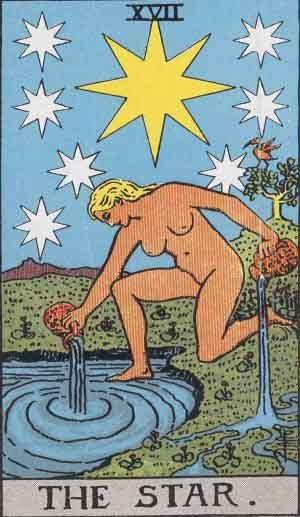
Depicted in the Smith-Waite version of the card is a nude woman, kneeling with one foot in the water. She holds two urns — one pouring water into a pool and another onto the ground. As the water pours onto the ground, it runs in five rivulets, which some say represent the five senses. Hanging above her in the sky is a large, central eight-pointed star surrounded by seven others. The ground behind her slopes upwards, and a fruit tree reaches towards the skies, an ibis perched on its branches. The woman in the center of the card commands as much, if not more, attention than the eponymous stars.
In his work The Pictorial Key to the Tarot, Arthur Edward Waite comments that the large star pictured is “l’étoile flamboyante” (the flaming star) from Masonic tradition. Reading A.E. White’s explanation of the card can act to confuse the modern tarot interpreter, especially with gems like “The summary of several tawdry explanations says that it is a card of hope. On other planes, it has been certified as immortality and interior light.” Given that the Kabbalah scholar helped author the deck, I tend to weigh his words pretty heavily. He also states that the figure in the card is Sephira Binah and representative of understanding.
So — is The Star a card of hope or a card of understanding — which is immortality and interior light?
Let me channel my inner Dr. Zoidberg and say — why not both? When I meditate on The Star, these concepts are intertwined.
It’s important to remember that The Star occurs after the disaster of the Tower. The loss represented in the Tower card is important to the revelation of the Star — that surrounding us, is everything we need to succeed.
The Five Cent Tarot by Madame Clara depicts two animals on the Star card — a regenerating eight legged starfish and the Ibis, representative of the Egyptian god Thoth, is there as well. In contemplating what this card has to offer, it becomes clear that the Star isn’t just about stars in the sky or the beautiful woman goddess, but it’s about that special something that we bring to our human experience. The star isn’t just about hope, but about the fact that hope represents the universe giving us our own understanding of our possibilities in addition to our limitations. In this way, the card is transformed into being more than just about hope, but also containing a story about our own ability to manifest what’s needed to heal, grow,and move on. It is through understanding how the universe provides that we can make space for our own transformation, change — and hope.
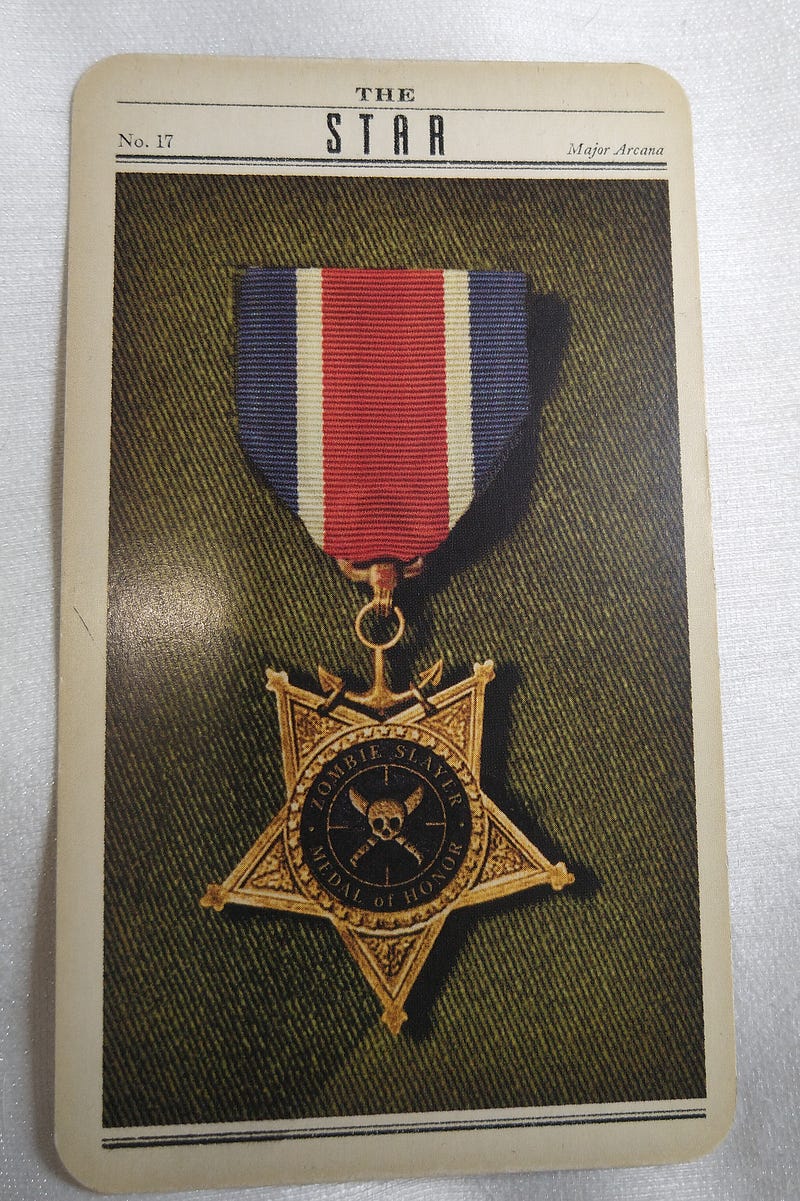
The Zombie Tarot by Paul Kepple and Stacey Graham offers reinforcement for this idea. Unlike other tarot decks, the sole focus of the Zombie Tarot is a five pointed star. In this case, it’s a five pointed star representing the “Zombie Slayer Medal of Honor,” which would definitely represent that the recipient would have all of the necessary skills to survive in an apocalypse of the undead. I do love the detail that the star is upside down.
Regardless of the deck in which it is encountered, the Star represents the ability to manifest change after even the most difficult of times, and the hope that capability brings.
Sources:
Text of The Pictorial Key to the Tarot by Arthur Edward Waite found at https://tarot.fandom.com/wiki/The_Star