Meditations on The Unknown
What the hell Tarot card is THAT? or — Meditations on Deck-Specific Tarot Cards
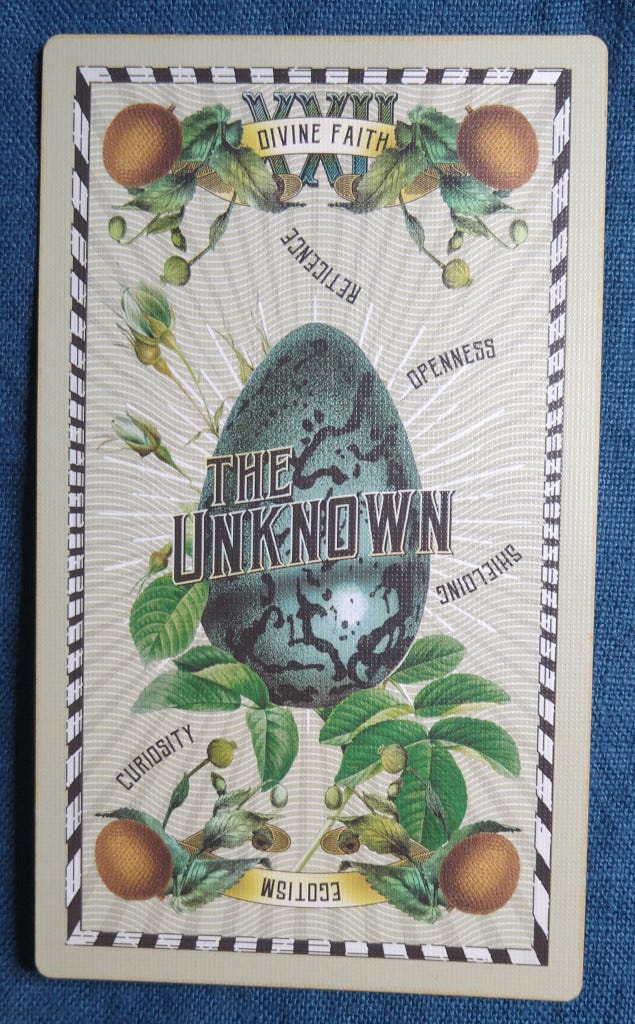
Today’s draw was The Unknown. Haven’t heard of it? It’s unknown, ha ha! In all seriousness, The Unknown is one of the deck-specific cards that was in my new (I love it so much) 5-Cent Tarot.
I’ve known a lot of tarot readers, and I’ve known a lot of tarot collectors. That Venn diagram isn’t a perfect circle — many people collect decks and don’t read them, and many read from only one deck. I don’t fit in either of those categories. While I’ve had extremely long-standing relationships with decks, the sort of nomad lifestyle I’ve lived for my 45 years means that inevitably, decks have moved in and out of my life. This means I’ve had the privilege to see a lot of decks — and that means, I get to see a lot of these special treasures.
Tarot cards are not the only divination tool out there — and many of the other divination tools and decks are also amazing tools for meditation. There are also more than one system of tarot, in addition to a host of oracle decks. At the heart of tarot’s usefulness as a meditation tool is its ability to evoke a situation or person or general archetype to the reader. These expansion, deck-specific cards allow for even more connection.
There are two major types of deck-specific cards I’ve noticed over my personal decks that I’ll explore.
Beyond-The-World Deck Specific Cards
5 Cent Tarot
The Little White Book (“LWB”) that comes with most decks will hint as to what the meanings of deck-specific card will be, but as usual it’s up to the reader to establish a relationship with the imagery and other clues offered on the cards. In most cases with the Rider-Waite-Smith system of cards, the card (or cards) will be in the Major Arcana and will follow The World card. My card today, The Unknown, is one such card — let’s take a look at my draw from this morning and consider the best way to meditate on this card, and how I saw it fit into my day today.
One of the defining features of the 5 Cent Tarot, besides the Victorian-era inspired artwork, are the helpful keywords on the card. Often, the 5 Cent Tarot’s simple, evocative imagery and keywords help me to look beyond, much as this card about the unknown (just beyond The World) does. Additionally, the 5 Cent Tarot includes more than just this deck-specific card (and it’s not my only deck that has more than one!). For this card, The Unknown, it has a number of 22. The keywords indicate that openness, divine faith, and curiosity are at play, in addition to the primal potential powers that the egg and closed flower buds call to mind.
What’s wonderful about this card, and many of the deck specific cards is how they can add on to the experience of a reading in addition to the decks themselves.
The Fountain Tarot
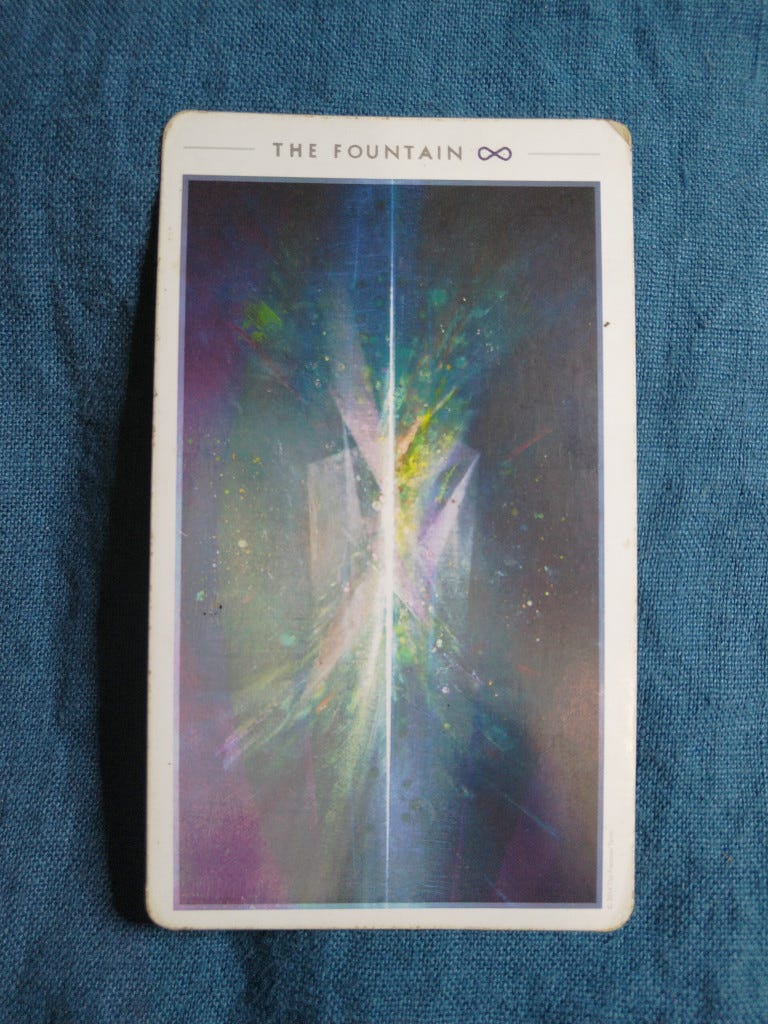
The Fountain Tarot, is a Rider-Waite-Smith deck with ethereal yet modern artwork that play on more contemporary archetypes and sensibilities. It should be no surprise that this deck also features one of these ‘card-beyond’ style cards with the eponymous “The Fountain” card, number: infinity. The Fountain, much like The Unknown, exists beyond — it is the wellspring, the awakening. The Little White Book’s description is suggestive of a card that doesn’t just represent the power of it all — but the reader’s own ability to sit back and observe. Much like The Unknown above, this card is about the Divine Nature Beyond the World, it is an invitation to pause and consider all that has been and can be.
The Ethereal Visions Tarot
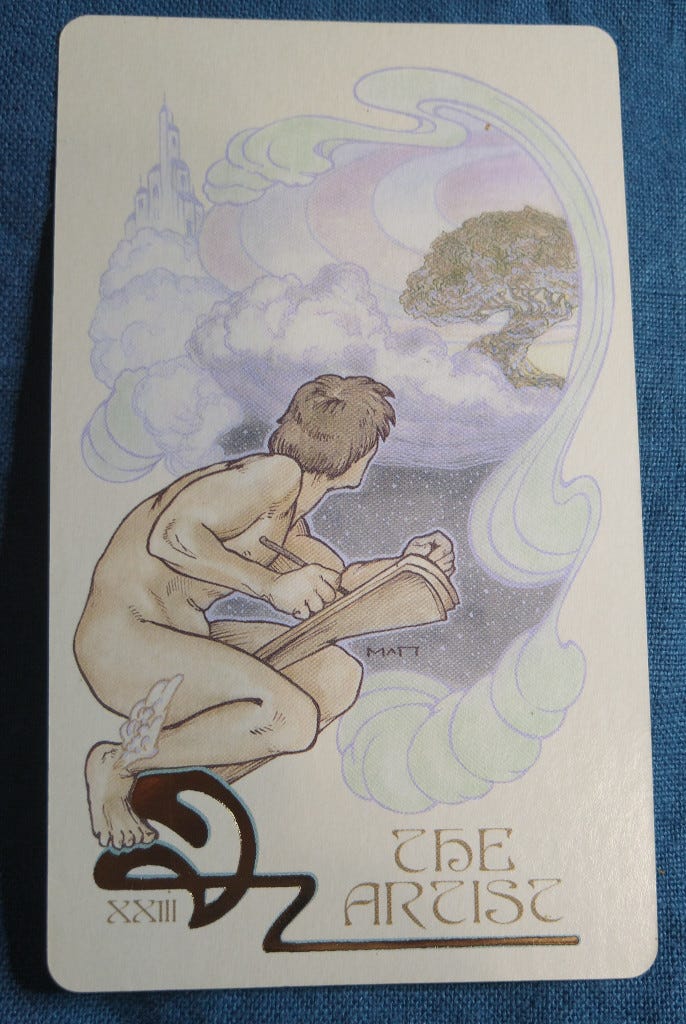
In Matt Hughes’ Ethereal Visions Tarot, there’s also more than one ‘card-beyond.’ In this case I’d like to highlight the second of these, number 23: The Artist. Much like the Unknown and The Fountain (or in Hughes’ case, The Well), The Artist evokes that concept of the beyond-world — and in this case the very vessel of creation himself, Ophiuchus. It is meant to ask the reader to put aside all biases of the human condition, and to experience the situation beyond just that. It’s a card of visionary, passionate surrender to all that is beyond the world. When I connect with and mediate on this card, I‘m reminded of Monica Bellucci in Twin Peaks: The Return, “We are like the dreamer who dreams, and then lives inside the dream. But who is the dreamer?”
Major Arcana Deck-Specific Variants
In other cases, you may see deck-specific variants within the Major Arcana itself.
Legacy of the Divine Tarot
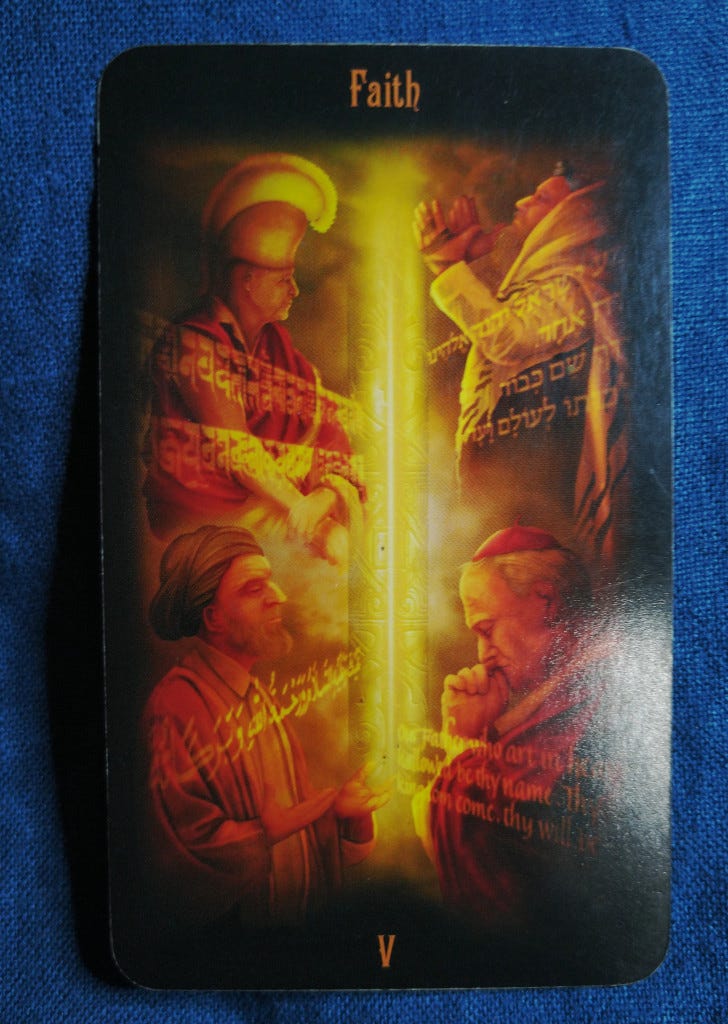
Ciro Marchetti’s Legacy of the Divine Tarot has such a substitution — in one of my favorite substituions, Marchetti replaces the Hierophant card with the Faith card. For me, with such a troublesome and troubled relationship with standard patriarchal religion, substituting a card that traditionally was emblematic of the Pope and Divine Law with a more inclusive vision of faith is far more appealing to me. Marcetti mentioned in the text that came with the cards that a similar substitution was performed in his prior deck, the Tarot of Dreams. Central to the card is the golden pillar, representing knowledge — and it is this pillar which is able to transcend and also connect all of the figures of religious leaders pictured in the card.
Barbara Walker’s Tarot
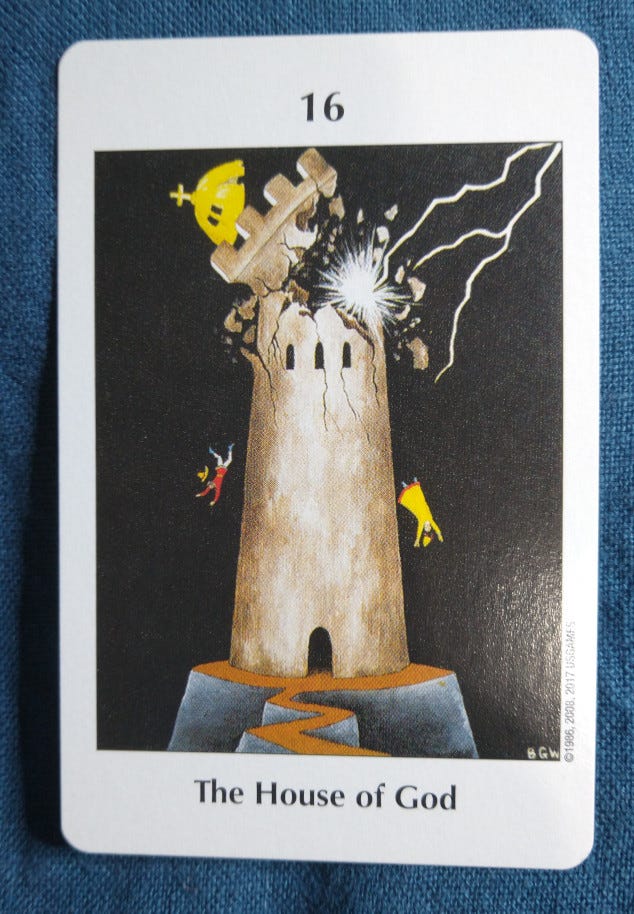
Barbara Walker’s deck, focused on stories of the Gods, also makes such substitutions, the most evocative of which I think to be for #16 of the tarot — traditionally known as The Tower, Barbara Walker calls it “The House of God,” (an interesting correspondence to “The Papess,” “The Pope”, as well as the imagery on the 10 of Wands we’ve discussed earlier).
Many tarot decks offer cards that are not in the standard deck (and some decks, like oracle decks, build their entire systems from the ground-up). These cards allow us to engage more fully with the deck and its artists, and to dive into the deeper meanings the deck’s imagery and art were intended to explore. Each of these unique cards offers an opportunity to meditate on an archetype not presented in the decks of their traditions, which ultimately adds to the relationship between you and the deck. Enjoy these lovely treasures!