Murder At Teal’s Pond: A Must-Read for Twin Peaks and True Crime Fans
Central to the story of Twin Peaks was the mystery about who Laura Palmer really was — much like what happened with Hazel Drew.
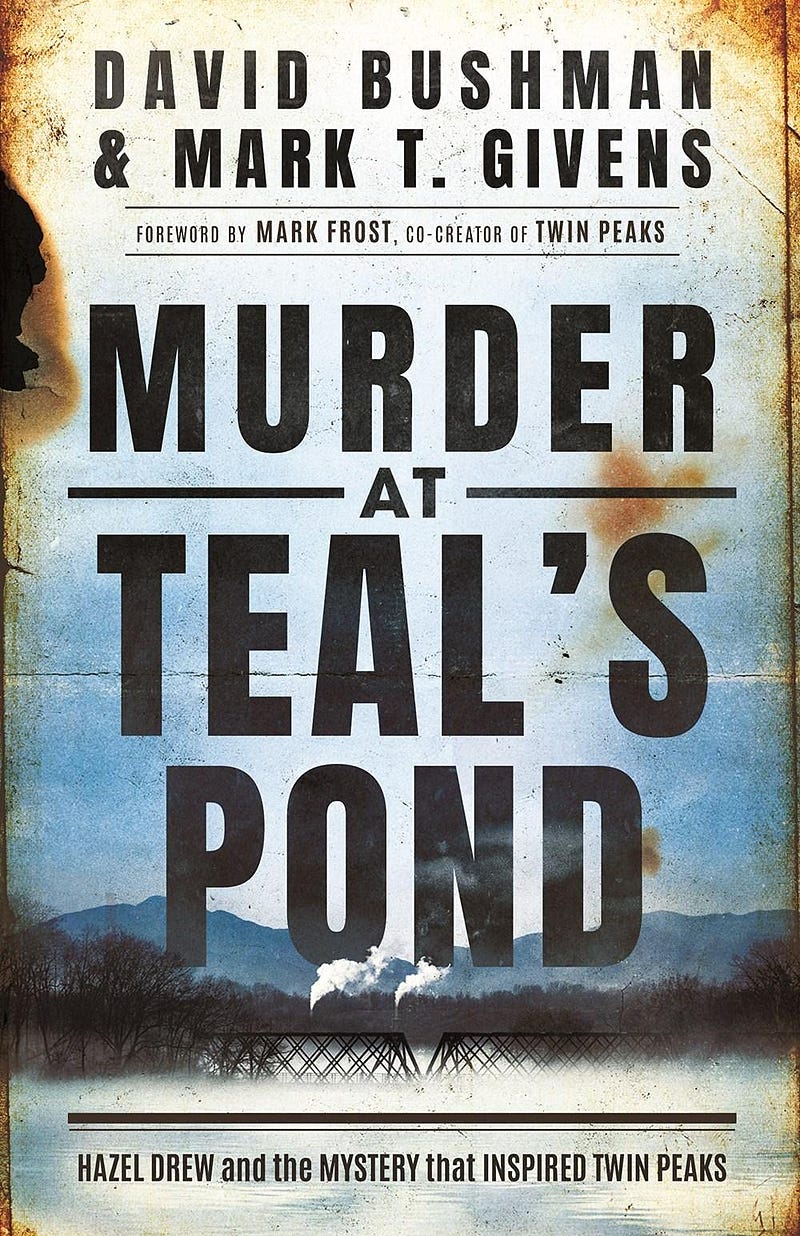
As a Twin Peaks fan, I ordered Murder at Teal’s Pond as soon as I had heard of it. As a person with a bad memory, I promptly forgot about it until I interacted with co-author David Bushman on Twitter.
I’m glad that I was reminded of it: not only was this page-turner selected as the Oxygen True Crime Book Club January pick but I also couldn’t personally put it down until it was done. David Bushman and Mark T. Givens spent years chasing down all of the clues that they could in order to write about ‘Hazel Drew and the Mystery That Inspired Twin Peaks,’ and their fastidious investigation has rendered an interesting narrative that follows the many strands of this fascinating case.
Twin Peaks, whose inciting event was the murder of Laura Palmer, spent an enormous amount of time trying to figure out exactly who Laura Palmer really was. This also happened with the people who had to investigate her historical counterpart, Hazel Irene Drew, who was murdered and her body dumped in Teal’s Pond in 1908. Hazel’s murder takes us on a narrative tour of the history and politics of Sand Lake, New York as well as nearby Troy, as Hazel, a woman of modest means, was connected to some of the most influential people in her environs.
Much like with the case of Laura Palmer, to understand Hazel Drew’s murder case also means that we must understand not only the place in which it happened and her possible murderers — but those investigating the crime as well. Bushman and Givens give background information on the political allegiances and overarching philosophies of those with the most power to steer the investigation.
I enjoyed the style of the narration itself which was never shy about plunging into detail, while also maintaining a lovely musicality to the prose. The authors’ sensitivity towards the subject herself was also deeply refreshing: there are several points where time is taken to explain how the male gaze influenced this case, as well as other cases at the time.
The level of detail is also top-notch: as a seamstress and Victwardian fangirl, I was delighted to hear the level of detail about Hazel’s clothing (which are actually important clues to the murder). Well-organized and with a clear structure, the book examines a number of facets about the investigation, people, and town that it is focused on. As clues about Hazel and her life are uncovered, we are treated to exceptional investigative detail on this cold case, which includes everything from ghost stories to a possible conspiratorial cover-up.
It’s also fascinating how much Hazel Drew’s murder really does resemble that of Laura Palmer in some of the tiny details: from heart-shaped necklaces to bounteous secrets, the two murders have more than just a water-logged victim in common. That’s particularly fascinating, because Mark Frost talks about the ghost story that inspired him in the foreward — a ghost story that at that point didn’t even include the victim’s name, which makes the coincidences even more fascinating.
As with many books of the genre, the book closes with the author’s thoughts on what might have really happened. While we may never know for certain what happened to Hazel Drew, I am grateful to the authors for making sure I knew more about who she was in addition to what happened to her.