Things I Think About When Editing For Robots
A marketing director for a cannabis business contacted me and asked if I would be interested in picking up some editing for them. They had…
A marketing director for a cannabis business contacted me and asked if I would be interested in picking up some editing for them. They had all of those writers, and they wanted one unifying voice.
If there’s one thing I’m very good at doing, it’s putting voice into something.
I said ‘sure,’ and she sent two big batches of stories that had been written. I quickly learned who the other writers were. But the way I discovered who they were got weird.
The discovery stemmed from this statement:
“Overall, the global CBD industry was worth over $5.3 billion in 2021.”
I don’t know why, but it felt off to me. It got even weirder when I clicked the link, which went to a Statista page for the US total CBD sales. At which point I thought ,“where the hell did they get THAT number and where does Statista get its information?”
That was when the phrasing struck me as strange. Why get a number for a US statistic and then state the value of the global market is “over” that?
My fastidiousness in attempting to source what I say, especially when it comes to cannabis science, is one part trauma response and two parts a journalism class or two in college.
But what really bothered me happened later on in the piece, “Marijuana is the fruiting buds that grow on the branches, stalk, stem, and leaves of the hemp plant. Marijuana contains tetrahydrocannabinol, or THC, which is the main psychoactive and euphoria-inducing element in the drug.”
At this point, I had to reach out to the client and tell them this was going to take more than editing and would take a full rewrite and vetting of the facts because there were a lot of out-and-out false statements.
As I waited for their response, I fed the text through a plagiarism detector. It passed with a 100%.
100%? I do a lot of editing for “Cannabis Explorations” and a lot of the best pieces I know were written by humans who weren’t copying off of people have scored 93, 94%. Phrases, etc. can be reused and can set off these detectors.
The marketing director’s response to my questions and cited passages made me certain of my theory.
“Is it AI?”
Can You Hear the Robots Sing?
I started researching the different AI writing tools out there, and fed them the tags, keywords, etc. Each of them happily regurgitated a similar outline — with a similar fixations. Several of them used the exact same Statista citations (with the same confusion between “US” and “Global”), and nearly all of them were incorrect in their definitions of what CBD and hemp are.
The more I poked around, the more I saw the AI fingerprints on text through the web. Simple questions, instead of having the strongest at- a-glance answers on Google, come up like this:
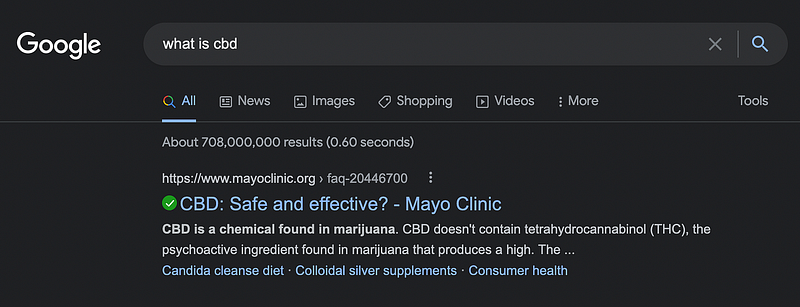
Any modern definition of a word related to cannabis that uses the racist term ‘marijuana’ is going to get a side-eye from me. Much less from Mayo Clinic?
Am I saying that AI wrote Mayo Clinic’s definition of CBD?
No. But I’m also not not saying that. And I’m also contending that since it’s so far up in the search results and by such a reputable domain, that AI might find that more ‘interesting’ as a fact. I’m more than aware of how people try to optimize their SEO and Domain Authority to push their results to the top — I have hundreds of unanswered emails asking me to post on my Medium account!
What I’m saying is — people are often reluctant to pay every day writers their worth. In the information age, more business owners are going to be turning to AI to save some money, and results on the internet are going to get weird. In the case of cannabis, this is going to be exceptionally difficult to navigate because of the prohibition and social stigma around its use.
That’s not to say that I don’t see the usefulness of tools like these. If your job is content creation on a massive scale, having an AI assistant perform some rudimentary research, etc. can be immensely helpful. But it’s been my experience through life and as someone who supported production systems in IT — that sometimes if you ask someone to check something, they don’t.
Singing the Songs of Angry Men.
It is known that a lie spreads faster than the truth, but it’d be hard to pinpoint the source of that knowledge. I wonder how much faster a perceived outrage travels.
These things have never been more true than on social media, and there are many, many people who use that to their advantage. One of the reasons I don’t engage in Facebook is I know how susceptible I can be to tricks like that. The reason is — it’s been my experience that my past trauma created a series of .. sensitivities in me.
And what is happening on Facebook (Meta, whatever they want to call themselves) is a lot of bots that would trigger those sensitivities— but I’m talking about AI.
That’s a step up from just bots.
As people try to throw websites up to capture more and more consumers via SEO, they’ll seek content at a cheaper and cheaper rate. They’ll use AI to generate text that’s essentially going to be Lie-om Ipsum. They won’t bother to have an editor to ‘unify’ the voice. If they do, the editor may not bother to check the veracity of the sources at all.
The more the major lines of information get corrupted, the more it will just enter into the realm of ‘common knowledge.’ Most people don’t have the time / bandwidth to check the sources for everything they read, much less three, much less have to do the burden to figure out which are reputable.
This leads many to instead just follow their feelings, or trusting what they read, and once you’ve heard something repeated enough, it just feels ‘more right.’ (That’s called repetition bias).
It’s not just text that’s becoming enweirdened, either. Videos are made from AI scripts.
A few weeks ago I stumbled on a video about fractal woodburning, that exceptionally dangerous practice that started to get a lot of people killed. That same creator, Ann Reardon, also made a video about Five Minute Crafts. I had FMC bookmarked for a while because they just seemed to escalate into doing more and more ridiculous things. I liked watching it in the same way my dad liked watching “Wally’s Workshop” when I was a kid — to make fun of it. Apparently not everyone watched for the same reasons.
Ann Reardon’s video below went into detail about Five Minutes Crafts, and how they are but one part of a massive empire of Russian-linked sites that operate under the banner of TheSoul Publishing. Take a look.
But Jamie, it’s just some dumb crafts. What does it even have to do with anything — who cares?
Well, we all should.
Misinformation (false or misleading information) and disinformation (misinformation deliberately spread to deceive people) are already difficult for people to detect much less understand. True information easily gets lost and flooded by misinformation and disinformation.
I’m not even sure what to call ai-generated misinformation, aisinformation?
Anyway, as more and more fake information gets poured into social media, it’s increasingly more difficult to sort through it all to find the ACTUAL information. Think of how many times you’ve looked to find a tutorial on how to use something — only to find the creator of the video has also never done it themselves (and maybe wasted 15 minutes of your time talking about it)?
This is exacerbated when bumped up against stuff that is designed to catch people’s attention and surf the algorithm to the top. Platforms have made SURE to separate themselves from the need to ensure that content is correct.
The more this happens the more crap we’re allowing our AI friends to lear, and we should be protecting them. AI is learning bad facts that have been written and rewritten to avoid plagiarism but are still incorrect, while also learning our biases. So it creates more bad content that passes all easy checks, that content gets fed up through search engines and their madness to be served up for more people to accept as gospel. . .
Don’t get me started on how one could buy their way to the top.
When the Beating of Your Heart Echoes the Beating of Their Drum
Telling people stupid ways to DIY a power plug, how to make pretty wood burnings by risking electrocution, or that watermelon is still delicious after being in cement in a year is one thing. It’s dangerous and terrible, but that’s hardly a concern of AI.
My worry is that this sort of just … stupid information will continue to feed AI — and that AI will fill in blanks where there is no information with the stupid and inaccurate. In the case of cannabis, where prohibition of the plant worked to create a black hole of stigma and misinformation, it creates a particularly delicate situation.
It also makes research ridiculously hard! Very few people have time for that.
The known impact of social media on mental health coupled with all of that also worries me. More and more people are driven to the internet to get help: and more and more the information will be out of sight. I have this theory that right now, everyone is carrying a bit of trauma thanks to the pandemic. One of the most common emotions that happens while dealing with a trauma, especially one that was over an extended period of time, is anger. Unfortunately, it’s also one of the easiest ways to manipulate people.
It’s been proven that it’s easy to get people to engage with content when they are angry. The more engagement — the more money.
Everything is Beautiful and Nothing Hurts
I didn’t write this to say that AI isn’t useful. Or won’t have some use. It does! We might also wield it so badly it helps kill us all before we get to use it to its fullest potential. Part of the danger is going to be the fact that AI is going to be used to separate us — from our dollar and each other — before anything else.
And yet, AI has some amazing potential.
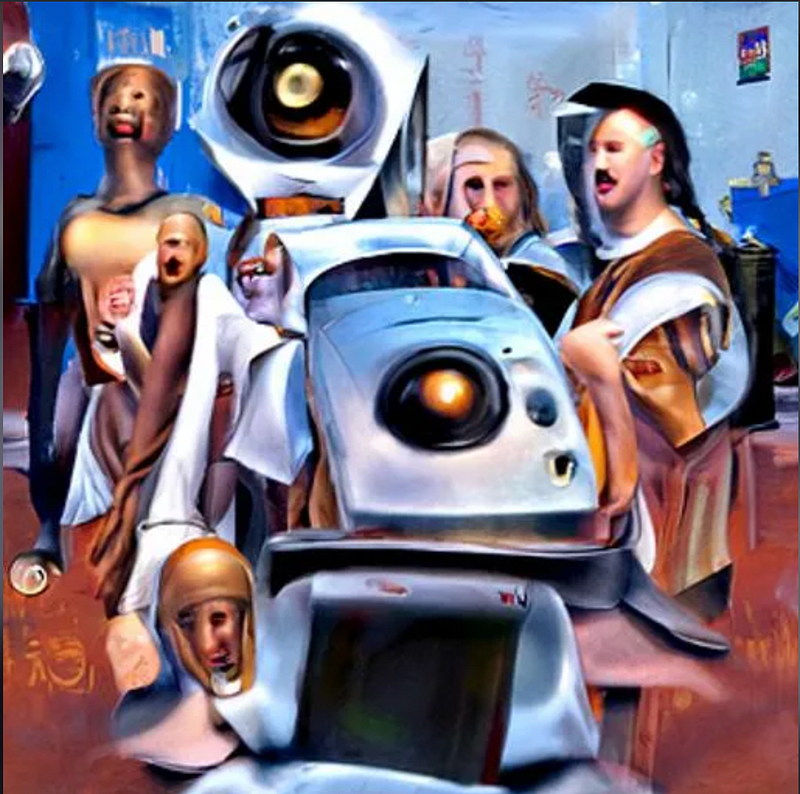
Take this piece, that was generated using AI using the following keywords “Disinformation centipede H.R. Giger Pablo Picasso Tim Burton brutalism bauhaus primitivism charcoal drawing”.

I evolved it a few iterations, and it’s quite striking. I’m sincerely interested in the imagery used. In this case, I gave it no image-based prompt. Why did it choose what it chose? What did it choose from?
AI has made stunning innovations and can help us create some marvelous masterpieces. It, along with social media, are impactful, amazing resources that hold a huge amount of potential for mankind. But as anyone knows, especially those of us that have spent any type of time in the data trenches: Garbage In; Garbage Out. And if you’ve ever tried to interpret some poorly coded logfiles, you know that humans make machines say the damndest things.
It’s made me think about my problems with my own authority: how I create a mixture of self-imposed obstacles to ensure I don’t write anything outside of my authority or ‘scope of practice’ as it were. But, I’ve spent so long in my life ‘reading by gaslight’, that it became the light I carried with me, if you can get the metaphor. So often I doubt my own knowledge to the point I’m sourcing nearly every sentence I write (which means trying to find three reputable sources that agree with it).
This philosophy is not shared by many in the media.
What happens when all the ‘reputable’ sources decide with their wallets? What will AI think then?
That’s why I’ve been quiet lately.